Blakiston's Fish Owlシマフクロウ
Ketupa blakistoniEN— Endangered
Blakiston's fish owl is one of the largest owls in the world, a huge fish-hunting owl of riverine forests in Hokkaido, Sakhalin, and the Russian Far East. Long revered by the Ainu people as a guardian deity, it has been pulled back from the brink of local extinction through decades of nest-box and winter-feeding programs in Japan.
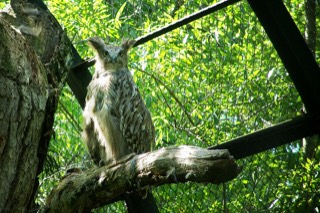 Blakiston's Fish Owl (reference photo)

Species Data
- Classification
- Strigiformes / Strigidae Source
- Size
- 63–71 cm
- Weight
- 3.4–4.1 kg
- Lifespan
- 20–30 years in the wild
- Diet
- Piscivore Feeds mainly on freshwater fish, and also on saltwater fish, amphibians, crustaceans, other birds, and small mammals; the only owl in Japan whose staple food is fish
- Distribution
- Found in central and eastern Hokkaido, Sakhalin, and the southern Kuril Islands, with additional populations of 250–400 birds in Russia's Primorsky region. Source
- Sources
- ja.wikipedia.org en.wikipedia.org
Did You Know?
- Its Hokkaido population fell to around 70 birds in the 1970s, but conservation efforts since 1984—including nest boxes and winter supplemental feeding—have helped it recover to about 165 birds in eastern Hokkaido today. Source
- Revered by the Ainu people of Hokkaido as "Kotan koru Kamuy," the god that protects the village, it is among the largest living owl species by weight and wingspan. Source
Where to See This Species
Operating facilities registered on this site: Japan 8
Kushiroshi DoubutsuenHokkaidoAbout 55 minutes from JR Kushiro Station by Akan Bus, or about 27 minutes (18 km) by car, taxi, or rental car.
Sapporoshimaruyama DoubutsuenHokkaidoOpened in 1951
Naganoshichausuyama DoubutsuenNaganoThe nearest station is JR Shinonoi Station.
Asahiyama ZooHokkaidoOpened in 1967
Hirakawa ZooKagoshimaAbout a 20-minute walk from Goino Station on the JR Ibusuki-Makurazaki Line, or take a bus bound for Taniyama / Dobutsuen from Fukuhira Nokyo-mae to the last stop.
Akitashioomoriyama DoubutsuenAkitaFrom bus stop 7 at the west exit of the JR Akita Station bus terminal, take the Akita Chuo Kotsu "Araya Line" bus for about 30 minutes.
NasudoubutsuoukokuTochigiAbout 50 minutes by car from Nasu-Shiobara Station on the Tohoku Shinkansen (a free shuttle bus is available; online reservation required by 17:00 the day before).
Source links to official sites, official YouTube channels, and news aggregators such as Zoo Ring. Visit the publisher for the full item.
Conservation Story
Conservation Status
Endangered (EN)
Sources
Support Conservation
A visit is a small, positive way to support the daily lives of the animals you care about.
- Visit
- A visit itself helps support the facility.
- Animal Supporter Programs & Giving
- Find ways to support the facility through its official website.
- Furusato Nozei
- Municipally run facilities may share official guidance for this Japanese hometown-tax program.
FAQ
- How rare is Blakiston's fish owl?
- It is one of the rarest owls in the world; Japan's population fell to roughly 70 birds in the 1970s and has since recovered to about 165 through sustained conservation work. Source
- What does Blakiston's fish owl eat?
- It hunts mainly freshwater fish from rivers and streams, but will also take amphibians, crustaceans, small mammals, and other birds. Source
- How many operating facilities are registered here?
- Operating facilities registered on this site: Japan 8 Source
Books & gear
Source: ja.wikipedia.org en.wikipedia.org