Blue Wildebeestオグロヌー
Connochaetes taurinusLC— Least Concern
The blue wildebeest is a large African antelope famed for its dramatic seasonal migrations across the grasslands of eastern and southern Africa, timed to follow the rains and fresh grass growth. The Serengeti population alone numbers roughly 1.3 million animals, making it one of the largest remaining large-mammal migrations on Earth. With a stable total population of about 1.5 million, the species is classified as Least Concern by the IUCN.
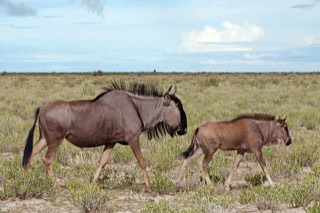 Blue Wildebeest (reference photo)
_female_and_calf.jpg)
Species Data
- Classification
- Artiodactyla / Bovidae Source
- Size
- Head-body length about 170–240 cm, height about 115–145 cm
- Weight
- Males about 165–290 kg, females about 140–260 kg
- Lifespan
- Captive: average about 20 years, record 24.3 years
- Diet
- Herbivore Herbivorous, preferring short grasses and grasslands on alkaline soils; browses on shrub leaves when grass is scarce
- Activity
- Active in the morning and evening, resting during the hottest hours; can run at 80 km/h
- Distribution
- The blue wildebeest occurs across eastern and southern Africa, including Kenya, Tanzania, Botswana, Zambia, Zimbabwe, Mozambique, South Africa, Eswatini, and Angola. It is extinct in Malawi but has been reintroduced in Namibia. Source
- Sources
- ja.wikipedia.org en.wikipedia.org
Did You Know?
- During the dry season, blue wildebeest undertake large-scale seasonal migrations toward areas with more rainfall and taller grass. Source
- The Serengeti population has grown to roughly 1.3 million animals, making it the largest and most famous of the remaining wildebeest migrations. Source
- Historically many large migrations existed, but over the past century all but three — the Serengeti, Tarangire, and Kafue migrations — have been disrupted, cut off, or lost entirely. Source
Where to See This Species
Operating facilities registered on this site: Japan 2
Hiroshima City Asa Zoological ParkHiroshimaFrom JR Hiroshima Station, take the Sanyo Main Line or Kabe Line to Shin-Hakushima Station, transfer to the Astram Line to Kamiyasu Station, then take a bus to "Asa Dobutsu Koen" (about 45 minutes in total).
Higashiyama Zoo and Botanical GardensAichiOpened in 1937
Conservation Story
Conservation Status
Least Concern (LC)
Sources
Support Conservation
A visit is a small, positive way to support the daily lives of the animals you care about.
- Visit
- A visit itself helps support the facility.
- Animal Supporter Programs & Giving
- Find ways to support the facility through its official website.
- Furusato Nozei
- Municipally run facilities may share official guidance for this Japanese hometown-tax program.
FAQ
- Why do blue wildebeest migrate?
- Their movements are timed to follow seasonal rainfall and grass growth, moving toward wetter areas with taller grass during the dry season. Source
- How large is the Serengeti wildebeest migration?
- The Serengeti population has grown to approximately 1.3 million animals, making it the largest of the remaining wildebeest migrations. Source
- Are blue wildebeest endangered?
- No. With a stable population estimated around 1.5 million, the blue wildebeest is classified as Least Concern by the IUCN. Source
- How many operating facilities are registered here?
- Operating facilities registered on this site: Japan 2 Source
Books & gear
Source: ja.wikipedia.org en.wikipedia.org