Caracalカラカル
Caracal caracalLC— Least Concern
The caracal is a slender, powerfully built wild cat found across Africa, the Middle East, Central Asia, and parts of India, distinguished by long black ear tufts. A skilled ambush predator, it feeds mainly on small mammals and birds and can leap more than 3 m into the air to catch birds in flight. Thanks to its wide distribution across more than 50 range countries, the IUCN classifies it as Least Concern.
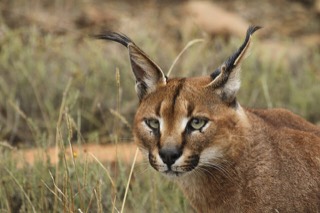 Caracal (reference photo)

Species Data
- Classification
- Carnivora / Felidae Source
- Size
- Body length about 61–108 cm, tail about 18–34 cm, shoulder height about 38–50 cm
- Weight
- Males about 8–20 kg, females about 6.2–16 kg
- Lifespan
- Wild: about 12 years; captive: about 16 years
- Diet
- Carnivore Carnivorous, eating birds, small antelopes, rodents, hares, hyraxes, and reptiles; small mammals make up more than 80% of its prey, and it can occasionally bring down prey 2–3 times its own weight
- Activity
- Essentially nocturnal but sometimes active by day; tends to be most active when temperatures fall below 20°C
- Distribution
- The caracal ranges across most of Africa south of the Sahara (excluding equatorial rainforest), the Arabian Peninsula, the Middle East, Central Asia, and parts of Pakistan and India. Source
Did You Know?
- The caracal's name derives from the Turkish word 'karakulak,' meaning 'black ear,' referencing the distinctive black tufts on its ear tips. Source
- Thanks to powerful hind legs, the caracal can leap more than 3 m into the air to snatch birds on the wing. Source
- In Iran and India, caracals were historically trained and used as hunting animals for catching birds. Source
Where to See This Species
Operating facilities registered on this site: Japan 5
Gokatsuraike Animal ParkMieAbout 10 minutes from the Seiwa-Taki Interchange.
Yokohama Shiritsu Nogeyama DoubutsuenKanagawaOpened in 1951
Himeji Shiritsu DoubutsuenHyogoOpened in 1951
Fukuyama Shiritsu DoubutsuenHiroshimaThere is no public transportation; access is by car.
- カラカルの愛称が決定しました!
- 【8/15 限定!コラボワークショップ】自分だけの動物図鑑づくり開催のお知らせ
- カラカルの命名式を開催します!
- カラカルスタンプラリー開催と新グッズ販売のお知らせ
- カラカルが来園しました!
- 「世界カラカル・カメの日」イベント開催のお知らせ
Source links to official sites, official YouTube channels, and news aggregators such as Zoo Ring. Visit the publisher for the full item.
Conservation Story
Conservation Status
Least Concern (LC)
Sources
Support Conservation
A visit is a small, positive way to support the daily lives of the animals you care about.
- Visit
- A visit itself helps support the facility.
- Animal Supporter Programs & Giving
- Find ways to support the facility through its official website.
- Furusato Nozei
- Municipally run facilities may share official guidance for this Japanese hometown-tax program.
FAQ
- Why is the caracal called the 'black ear' cat?
- Its name comes from the Turkish word 'karakulak,' meaning black ear, a reference to the long black tufts on the tips of its ears. Source
- How high can a caracal jump?
- It can leap more than 3 m straight up, a skill it uses to knock birds out of the air. Source
- Is the caracal endangered?
- No, the caracal is classified as Least Concern by the IUCN, owing to its wide distribution across more than 50 countries in Africa and Asia. Source
- How many operating facilities are registered here?
- Operating facilities registered on this site: Japan 5 Source
Books & gear
Source: ja.wikipedia.org en.wikipedia.org