Golden Lion Tamarinゴールデンライオンタマリン
Leontopithecus rosaliaEN— Endangered
The golden lion tamarin (Leontopithecus rosalia) is a small, strikingly orange primate endemic to the Atlantic coastal forests of Rio de Janeiro state, Brazil. Named for the mane-like fur framing its face, it lives in small family groups and feeds mainly on fruit supplemented by insects and small vertebrates. Once reduced to about 200 individuals, it has become one of primatology's leading conservation success stories, though it remains classified as Endangered.
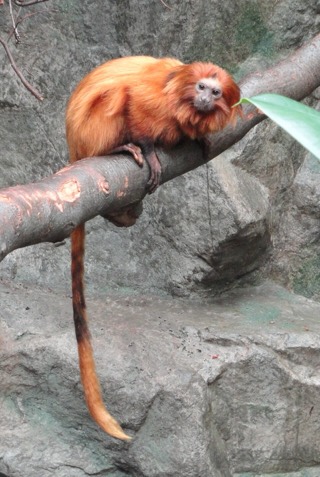 Golden Lion Tamarin (reference photo)

Species Data
- Classification
- Primates / Callitrichidae Source
- Size
- 25–31 cm (tail 31.5–40 cm)
- Weight
- 0.6–0.9 kg
- Lifespan
- Over 15 years
- Diet
- Omnivore Omnivorous, eating fruit, nectar, tree gum, insects, land snails, frogs, lizards, and bird eggs; fruit makes up more than 80% of the diet
- Activity
- Diurnal
- Distribution
- Endemic to the Atlantic coastal forests of Brazil, restricted to the São João River basin area of Rio de Janeiro state. Source
- Sources
- ja.wikipedia.org en.wikipedia.org
Did You Know?
- Numbers fell to an estimated 200 individuals in the 1960s but have since recovered to roughly 2,500-4,800 through habitat protection and captive breeding, making it a celebrated conservation success story. Source
- Extra-long hairs around its face and ears form a mane-like ruff, the source of its 'lion tamarin' name. Source
- It has claw-like nails rather than flat nails, an adaptation suited to probing tree bark for insect prey. Source
Where to See This Species
Operating facilities registered on this site: Japan 3
Hamamatsu Zoological GardensShizuokaOpened in 1950
Fukuoka Zoo & Botanical GardenFukuokaOpened in 1953
Conservation Story
Conservation Status
Endangered (EN)
Sources
Support Conservation
A visit is a small, positive way to support the daily lives of the animals you care about.
- Visit
- A visit itself helps support the facility.
- Animal Supporter Programs & Giving
- Find ways to support the facility through its official website.
- Furusato Nozei
- Municipally run facilities may share official guidance for this Japanese hometown-tax program.
FAQ
- Why is the golden lion tamarin endangered?
- Deforestation of Brazil's Atlantic coastal forest fragmented its habitat and shrank the wild population to roughly 200 individuals by the 1960s. Source
- Has the species recovered?
- Yes. Through habitat protection, reintroduction, and captive breeding programs, the population has grown to an estimated several thousand individuals, though it remains Endangered. Source
- How many operating facilities are registered here?
- Operating facilities registered on this site: Japan 3 Source
Books & gear
Source: ja.wikipedia.org en.wikipedia.org