Japanese Bullhead Sharkネコザメ
Heterodontus japonicusLC— Least Concern
The Japanese bullhead shark (Heterodontus japonicus) is a small, nocturnal shark found along the coasts of Japan, Korea, and China, typically in shallow, rocky or kelp-covered waters 6-37 meters deep. It uses blunt, molar-like rear teeth to crush hard-shelled prey such as turban snails, sea urchins, and crustaceans, earning it the Japanese nickname "sazae-wari" (turban-snail cracker). It is classified as Least Concern by the IUCN.
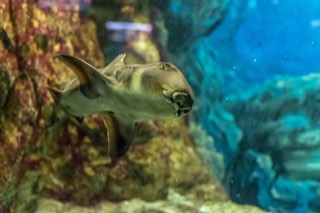 Japanese Bullhead Shark (reference photo)

Species Data
- Classification
- Heterodontiformes / Heterodontidae Source
- Size
- Maximum total length about 120 cm
- Diet
- Carnivore Favors mollusks such as turban snails, sea urchins, crustaceans, and small fish
- Activity
- Nocturnal (hides among seaweed and rocks during the day)
- Distribution
- Found in the northwest Pacific from Japan (south of Hokkaido) to the Korean Peninsula and the coast of China to Taiwan, on the continental shelf at depths of 6-37 m. Source
- Sources
- ja.wikipedia.org en.wikipedia.org
Did You Know?
Where to See This Species
Operating facilities registered on this site: Japan 5
Kagoshima City AquariumKagoshimaFrom Kagoshima-Chuo Station, take the tram (Route 2) to the Suizokukan-guchi stop and walk 8 minutes.
NOTOJIMA AQUARIUMIshikawaThe nearest station is Wakura-Onsen Station.
Shimoda AquariumShizuokaOpened in 1967
Kyoto AquariumKyotoAbout a 15-minute walk from the central exit of JR Kyoto Station.
Toba AquariumMieOpened in 1955
Source links to official sites, official YouTube channels, and news aggregators such as Zoo Ring. Visit the publisher for the full item.
Conservation Story
Conservation Status
Least Concern (LC)
Sources
Support Conservation
A visit is a small, positive way to support the daily lives of the animals you care about.
- Visit
- A visit itself helps support the facility.
- Animal Supporter Programs & Giving
- Find ways to support the facility through its official website.
- Furusato Nozei
- Municipally run facilities may share official guidance for this Japanese hometown-tax program.
FAQ
- What does the Japanese bullhead shark eat?
- It preys mainly on hard-shelled animals such as turban snails, sea urchins, and crustaceans, crushing them with its flattened, molar-like rear teeth. Source
- Is the Japanese bullhead shark dangerous to humans?
- No, it is a harmless, slow-moving bottom-dweller that divers can safely approach and even hand-catch. Source
- How long do its eggs take to hatch?
- About a year; the newly hatched young measure roughly 18 cm long. Source
- How many operating facilities are registered here?
- Operating facilities registered on this site: Japan 5 Source
Books & gear
Source: ja.wikipedia.org en.wikipedia.org