Japanese Charイワナ
Salvelinus leucomaenisLC— Least Concern
The Japanese char (Salvelinus leucomaenis), known as iwana in Japan, is a salmonid native to cold mountain streams of Hokkaido and northern Honshu, as well as northeastern Korea, Sakhalin, the Kuril Islands, and Kamchatka. Both landlocked stream populations and anadromous, sea-run forms occur, and the species is a voracious predator of aquatic insects, crustaceans, and smaller fish. It is listed as Least Concern by the IUCN.
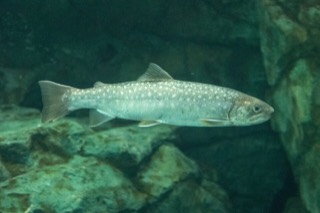 Japanese Char (reference photo)

Species Data
- Classification
- Salmoniformes / Salmonidae Source
- Size
- Varies greatly by regional population: about 25–35 cm in stream-resident forms, while the sea-run form (amemasu) reaches around 120 cm at maximum
- Lifespan
- Wild: about 6 years / captive: some have reached nearly 30 years
- Diet
- Carnivore Voracious carnivore, eating zooplankton, aquatic insects, other fish, freshwater crabs, terrestrial insects that fall into the water, frogs, and salamanders
- Distribution
- Native to cold mountain streams of Hokkaido and northern Honshu, as well as northeastern Korea, Sakhalin, the Kuril Islands, and Kamchatka. Source
- Sources
- ja.wikipedia.org en.wikipedia.org
Did You Know?
Where to See This Species
Operating facilities registered on this site: Japan 2
Kyoto AquariumKyotoAbout a 15-minute walk from the central exit of JR Kyoto Station.
Sapporo Salmon MuseumHokkaido
Conservation Story
Conservation Status
Least Concern (LC)
Sources
Support Conservation
A visit is a small, positive way to support the daily lives of the animals you care about.
- Visit
- A visit itself helps support the facility.
- Animal Supporter Programs & Giving
- Find ways to support the facility through its official website.
- Furusato Nozei
- Municipally run facilities may share official guidance for this Japanese hometown-tax program.
FAQ
- What is a Japanese char (iwana)?
- It is a salmonid fish native to cold streams in Japan and neighboring parts of East Asia, occurring in both landlocked and sea-run (anadromous) forms. Source
- Where does the Japanese char live?
- It inhabits mountain streams in Hokkaido and northern Honshu, plus northeastern Korea, Sakhalin, the Kuril Islands, and Kamchatka. Source
- Why do Japanese char turn darker in winter?
- Individuals develop a darker coloring in the coldest months, called "sabi" by anglers, which fades as water warms and feeding resumes. Source
- How many operating facilities are registered here?
- Operating facilities registered on this site: Japan 2 Source
Books & gear
Source: ja.wikipedia.org en.wikipedia.org