Japanese Horseshoe Crabカブトガニ
Tachypleus tridentatusEN— Endangered
The Japanese horseshoe crab is a living fossil that has changed little since the Paleozoic era, now surviving mainly on a handful of protected tidal flats in Japan after widespread habitat loss along the Seto Inland Sea. Its blue, copper-based blood clots in response to bacterial toxins, making it a critical resource for pharmaceutical safety testing worldwide.
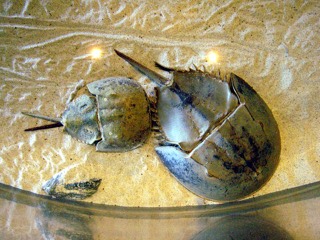 Japanese Horseshoe Crab (reference photo)

Species Data
- Classification
- Xiphosura / Limulidae Source
- Size
- Males 45–70 cm in total length, females 55–85 cm (from the front of the carapace to the tip of the tail spine)
- Lifespan
- Takes about 4 years to grow from egg to adult, passing through 15 instars and 14 molts
- Diet
- Omnivore Omnivorous benthic animal that eats polychaetes and other worms, mollusks, other benthic invertebrates, and algae
- Distribution
- Historically widespread along the Seto Inland Sea and northern Kyushu coasts of Japan, it is now largely restricted to a few tidal flats such as Imari Bay (Saga), Nakatsu (Oita), and Kasaoka (Okayama); it also occurs along coastal China, Taiwan, Korea, and Southeast Asia. Source
- Sources
- ja.wikipedia.org en.wikipedia.org
Did You Know?
- Its copper-based hemocyanin gives the blood a blue color, and because it clots in response to bacterial endotoxins and fungal beta-D-glucans, the blood is used in safety testing for pharmaceuticals and medical devices. Source
- Because it retains a body plan little changed from its Paleozoic-era relatives, it is often called a "living fossil." Source
- In Saijo, Ehime Prefecture, the sight of males and females moving together has made it a symbol of marital harmony, and several of its breeding grounds, including those in Imari, Kasaoka, and Saijo, are designated national natural monuments. Source
Where to See This Species
Operating facilities registered on this site: Japan 6
Echizen Matsushima AquariumFukuiOpened in 1959
Nagasakipengin SuizokukanNagasakiOpened in 2001
Toba AquariumMieOpened in 1955
Noboribetsu Marine Park NIXEHokkaidoAbout a 5-minute walk from JR Noboribetsu Station.
Former facilities
Shima MarinelandMieOpened in 1970
Closed: 2021-03-31 Official Site
Conservation Story
Conservation Status
Endangered (EN)
Sources
Support Conservation
A visit is a small, positive way to support the daily lives of the animals you care about.
- Visit
- A visit itself helps support the facility.
- Animal Supporter Programs & Giving
- Find ways to support the facility through its official website.
- Furusato Nozei
- Municipally run facilities may share official guidance for this Japanese hometown-tax program.
FAQ
- Why is the Japanese horseshoe crab called a living fossil?
- Its body plan has remained largely unchanged since relatives that lived in the Paleozoic era hundreds of millions of years ago. Source
- Why is the horseshoe crab's blood valuable?
- Its blue, copper-based blood clots when exposed to bacterial endotoxins and fungal compounds, so it is extracted and used to test the safety of drugs and medical equipment. Source
- Where can the Japanese horseshoe crab still be found in Japan?
- It survives mainly in a few protected tidal flats such as Imari Bay in Saga, Nakatsu in Oita, and Kasaoka in Okayama, after being lost from much of its former range around the Seto Inland Sea and northern Kyushu. Source
- How many operating facilities are registered here?
- Operating facilities registered on this site: Japan 6 Source
Books & gear
Source: ja.wikipedia.org en.wikipedia.org