Japanese Sea Cucumberマナマコ
Apostichopus japonicusEN— Endangered
The Japanese sea cucumber is a common sediment-feeding echinoderm found in shallow coastal waters from Russia and Japan to Korea and China, occurring in red, green, and black color morphs that represent genetically distinct populations. Long valued as a food source in East Asia, it can fully regenerate its digestive organs within months of expelling them.
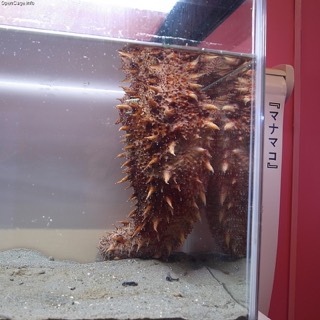 Japanese Sea Cucumber (reference photo)

Species Data
- Classification
- Aspidochirotida / Stichopodidae Source
- Size
- Body length generally about 15–24 cm
- Lifespan
- Thought to live at least 5 years (juveniles reared by artificial fertilization have been found 5 years later)
- Diet
- Other Swallows sediment whole to feed on organic matter, diatoms, dinoflagellates, and fragments of dead eelgrass that accumulate on the seafloor
- Distribution
- Found along the coasts of Russia, China, Japan, and Korea, ranging from Sakhalin south to the Amami Islands, typically in shallow waters from the intertidal zone to about 20 m depth. Source
- Sources
- ja.wikipedia.org en.wikipedia.org
Did You Know?
- It has three color morphs - red, green ("ao"), and black - which occupy different depths and habitats and are genetically distinct populations rather than a simple color variation. Source
- After expelling its internal organs, it can fully regenerate its digestive system within about two months. Source
- During the Edo period it was processed into dried "iriko" as one of Japan's three major trade goods for China, and today its salted intestines ("konowata") and dried gonads ("kuchiko") are still prized delicacies. Source
Where to See This Species
Operating facilities registered on this site: Japan 1
Nagasakipengin SuizokukanNagasakiOpened in 2001
Source links to official sites, official YouTube channels, and news aggregators such as Zoo Ring. Visit the publisher for the full item.
Conservation Story
Conservation Status
Endangered (EN)
Sources
Support Conservation
A visit is a small, positive way to support the daily lives of the animals you care about.
- Visit
- A visit itself helps support the facility.
- Animal Supporter Programs & Giving
- Find ways to support the facility through its official website.
- Furusato Nozei
- Municipally run facilities may share official guidance for this Japanese hometown-tax program.
FAQ
- What does the Japanese sea cucumber eat?
- It feeds by swallowing sediment along with the organic matter, diatoms, and decaying seagrass fragments mixed into it. Source
- Why does this sea cucumber come in different colors?
- It has red, green, and black color morphs that inhabit different depths and are genetically distinct populations rather than simple individual variation. Source
- Can it really regenerate its organs?
- Yes. If it expels its internal organs as a defense response, it can fully regrow its digestive system within about two months. Source
- How many operating facilities are registered here?
- Operating facilities registered on this site: Japan 1 Source
Books & gear
Source: ja.wikipedia.org en.wikipedia.org