Koalaコアラ
Phascolarctos cinereusVU— Vulnerable
The koala (Phascolarctos cinereus) is a tree-dwelling marsupial of eastern Australia's eucalypt forests, spending up to 20 hours a day asleep and feeding almost exclusively on eucalyptus leaves. Uniquely, mothers pass gut bacteria to their young through a specialized form of feces, allowing them to digest the toxic leaves. Populations have declined sharply from habitat loss, bushfires, vehicle strikes, and chlamydia disease, and the species is classified as Vulnerable, with some Australian states listing it as endangered.
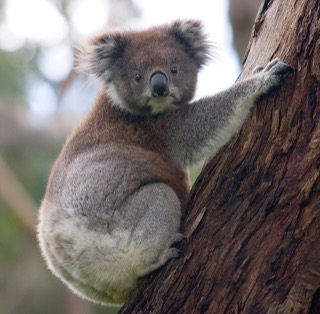 Koala (reference photo)

Species Data
- Classification
- Diprotodontia / Phascolarctidae Source
- Size
- Queensland animals: males 674–736 mm, females 648–723 mm; southern animals: males 750–820 mm, females 680–730 mm
- Weight
- Queensland animals: males 4.2–9.1 kg, females 4.1–7.3 kg; southern animals: males 9.5–14.9 kg, females 7–11 kg
- Lifespan
- Wild: females up to 18 years (males somewhat less)
- Diet
- Herbivore Herbivorous, feeding mainly on eucalyptus along with the leaves and young shoots of acacia and tea tree; eats 500 g to over 1 kg a day
- Activity
- Crepuscular; spends 18–20 hours or more a day sleeping or resting, and is most active in early morning and evening
- Distribution
- Found along coastal eucalypt forests of eastern Australia, spanning southeastern Queensland, eastern New South Wales, Victoria, and southeastern South Australia. Source
- Sources
- ja.wikipedia.org en.wikipedia.org
Did You Know?
- Its caecum measures roughly 2 meters long, among the largest relative to body size of any animal, and it produces specialized enzymes to neutralize toxic compounds in eucalyptus leaves. Source
- Mothers feed a specialized form of feces to their young to transmit the gut bacteria needed to digest eucalyptus, a behavior found in few other animals. Source
- Its name derives from the Dharug word 'gula,' meaning roughly 'no water,' reflecting how little it needs to drink. Source
Where to See This Species
Operating facilities registered on this site: Japan 9
Hirakawa ZooKagoshimaAbout a 20-minute walk from Goino Station on the JR Ibusuki-Makurazaki Line, or take a bus bound for Taniyama / Dobutsuen from Fukuhira Nokyo-mae to the last stop.
Higashiyama Zoo and Botanical GardensAichiOpened in 1937
Asahiyama ZooHokkaidoOpened in 1967
Yokohama Shiritsu Kanazawa DoubutsuenKanagawaOpened in 1982
Saitamakenkodomodoubutsu Shizen KouenSaitamaOpened in 1980
Nagasaki Bio ParkNagasakiOpened in 1980
Tennoji ZooOsakaOpened in 1915
- 日替わり開催!10月の飼育員いちおし!
- 【東山動植物園公式】2026コアラの愛称投票開催中!!(園内のみ)《 コアラ 》
- 【東山動植物園公式】コアラの赤ちゃん成長記3(2026.8.31撮影)《 コアラ 》 #コアラの赤ちゃん #動物の赤ちゃん #short #癒し #animals #動物
- 飼育頭数日本一!平川動物公園のコアラ応援プロジェクト ~クラウドファンディング型ふるさと納税へのお願い~
- 日替わり開催!9月の飼育員いちおし!
- 【東山動植物園公式】コアラの赤ちゃん成長記2(2026.8.3撮影)《 コアラ 》 #コアラの赤ちゃん #動物の赤ちゃん #short #癒し #animals #動物
Source links to official sites, official YouTube channels, and news aggregators such as Zoo Ring. Visit the publisher for the full item.
Conservation Story
Conservation Status
Vulnerable (VU)
Sources
Support Conservation
A visit is a small, positive way to support the daily lives of the animals you care about.
- Visit
- A visit itself helps support the facility.
- Animal Supporter Programs & Giving
- Find ways to support the facility through its official website.
- Furusato Nozei
- Municipally run facilities may share official guidance for this Japanese hometown-tax program.
FAQ
- Why do koalas sleep so much?
- Eucalyptus leaves are low in nutrients and energy, so koalas conserve energy by sleeping up to 20 hours a day. Source
- What are the main threats to koalas?
- Habitat destruction from urbanization and land clearing, bushfires, vehicle and dog strikes, and chlamydia disease are the leading threats, contributing to a population decline of tens of thousands in recent years. Source
- How many operating facilities are registered here?
- Operating facilities registered on this site: Japan 9 Source
Books & gear
Source: www.tokyo-zoo.net hirakawazoo.jp www.higashiyama.city.nagoya.jp www.iucnredlist.org