Large Tree Nymphオオゴマダラ
Idea leuconoeNE— Not Evaluated
The large tree nymph is Japan's largest butterfly, with a wingspan reaching 13 cm, found across the Ryukyu Islands from Okinawa to Kikai Island. Its larvae feed on toxic vine leaves and store the poison in their bodies, and it is famous for its golden, structurally colored chrysalis. Because it depends on a limited host plant, its range is patchy, and the town of Kikai has banned capturing it by ordinance.
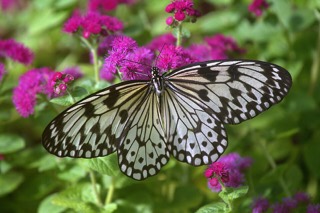 Large Tree Nymph (reference photo)

Species Data
- Classification
- Lepidoptera / Nymphalidae Source
- Size
- Forewing length about 7 cm and wingspan up to 13 cm, making it one of the largest butterflies in Japan
- Lifespan
- Lives several months after emergence, up to about half a year under good conditions
- Diet
- Herbivore Larvae feed on the leaves of Parsonsia alboflavescens and Tylophora tanakae (family Apocynaceae) and accumulate the plants' alkaloid toxins in their bodies; the toxins persist in the adult
- Distribution
- In Japan, found from Kikai and Yoron islands southward through the Ryukyu Islands, with a broader range across Southeast Asia and Taiwan; it breeds year-round in Okinawa. Source
- Sources
- ja.wikipedia.org en.wikipedia.org
Did You Know?
- Its chrysalis appears golden, a result of structural coloration rather than pigment, and takes about a week to emerge in summer or up to a month in winter. Source
- Its slow, graceful gliding flight has earned it the nickname "lady of the tropics" in Japanese. Source
- It is designated the official prefectural butterfly of Okinawa and the official butterfly of several municipalities as well. Source
Where to See This Species
Operating facilities registered on this site: Japan 2
Adachi Park of Living ThingsTokyoAbout 20 minutes on foot from the east exit of Takenotsuka Station on the Tobu Skytree Line.
Conservation Story
Conservation Status
Not Evaluated (NE)
Sources
Support Conservation
A visit is a small, positive way to support the daily lives of the animals you care about.
- Visit
- A visit itself helps support the facility.
- Animal Supporter Programs & Giving
- Find ways to support the facility through its official website.
- Furusato Nozei
- Municipally run facilities may share official guidance for this Japanese hometown-tax program.
FAQ
- Why is the chrysalis of this butterfly gold?
- The golden appearance comes from structural coloration in the chrysalis rather than pigment; it takes about a week to emerge in summer or up to a month in winter. Source
- How does this butterfly become toxic?
- Its larvae feed on the leaves of alkaloid-containing vines such as Parsonsia species, storing the toxins in their bodies, a defense that persists into adulthood. Source
- Is this butterfly protected?
- There is no national threatened-species listing, but the town of Kikai, near the species' northern range limit, enacted an ordinance in 1989 banning its capture due to its dependence on a limited host plant. Source
- How many operating facilities are registered here?
- Operating facilities registered on this site: Japan 2 Source
Books & gear
Source: ja.wikipedia.org en.wikipedia.org