Leopard Tortoiseヒョウモンガメ
Stigmochelys pardalisLC— Least Concern
The leopard tortoise is the fourth-largest tortoise species in the world, native to the arid savannas and grasslands of eastern and southern Africa. Named for its blotched, leopard-like shell pattern, which provides camouflage in grassland habitat, it is a herbivorous grazer capable of reaching 40 to 70 cm in shell length and living 80 to 100 years. Females lay unusually large numbers of eggs across multiple clutches each year, with an incubation period that can stretch beyond a year.
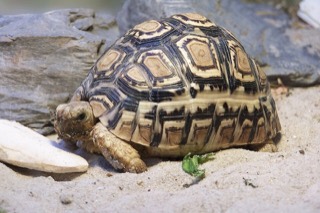 Leopard Tortoise (reference photo)

Species Data
- Classification
- Testudines / Testudinidae Source
- Size
- Carapace length generally around 40 cm, reaching up to 70.5 cm in large populations
- Weight
- About 13 kg for a typical individual; up to 40 kg in large populations
- Lifespan
- Said to live about 80–100 years
- Diet
- Herbivore Herbivorous, eating grasses, herbs such as thistles, succulents, fruit, and mushrooms; sometimes gnaws bones or ash for calcium
- Activity
- Basically diurnal, but less active in hot periods and the dry season
- Distribution
- Widely distributed across the arid and savanna regions of eastern and southern Africa, from South Sudan and Somalia through East Africa to South Africa and Namibia, at elevations up to 2,900 m. Source
- Sources
- ja.wikipedia.org en.wikipedia.org
Did You Know?
- It is considered the fourth-largest tortoise species in the world, and its namesake leopard-like blotched pattern is thought to serve as camouflage in grassland habitat. Source
- When shifting home ranges, individuals may travel 20 to 50 km at a stretch—an unusually large movement range for a tortoise. Source
- Females are prolific breeders, laying 5 to 30 eggs per clutch across as many as 5 to 7 clutches a year, with an unusually long incubation period of 8 to 15 months. Source
Where to See This Species
Operating facilities registered on this site: Japan 3
Ishikawa DoubutsuenIshikawaAbout 60 minutes from the Kanazawa-Morimoto Interchange on the Hokuriku Expressway, about 40 minutes from the Kanazawa-Nishi Interchange, and about 20 minutes from the Komatsu Interchange.
Wan Park Kouchianimaru LandKochiAddress: 6-9-1 Sanbashi-dori, Kochi (inside Wanpark Kochi).
Naganoshichausuyama DoubutsuenNaganoThe nearest station is JR Shinonoi Station.
Source links to official sites, official YouTube channels, and news aggregators such as Zoo Ring. Visit the publisher for the full item.
Conservation Story
Conservation Status
Least Concern (LC)
Sources
Support Conservation
A visit is a small, positive way to support the daily lives of the animals you care about.
- Visit
- A visit itself helps support the facility.
- Animal Supporter Programs & Giving
- Find ways to support the facility through its official website.
- Furusato Nozei
- Municipally run facilities may share official guidance for this Japanese hometown-tax program.
FAQ
- How big does a leopard tortoise get?
- Most adults reach around 40 cm in shell length and 13 kg, though individuals from larger northern and southern populations can grow up to about 70 cm and 40 kg, making it the fourth-largest tortoise species in the world. Source
- How long do leopard tortoises live?
- They are long-lived reptiles, with lifespans commonly estimated at 80 to 100 years. Source
- How many eggs does a leopard tortoise lay?
- Females can lay 5 to 30 eggs per clutch and produce as many as 5 to 7 clutches in a single year, though the eggs take an unusually long 8 to 15 months to incubate before hatching. Source
- How many operating facilities are registered here?
- Operating facilities registered on this site: Japan 3 Source
Books & gear
Source: ja.wikipedia.org en.wikipedia.org