Peacock Mantis Shrimpモンハナシャコ
Odontodactylus scyllarusLC— Least Concern
The peacock mantis shrimp is a large, brilliantly colored stomatopod found on Indo-Pacific coral reefs from East Africa to Japan and Australia. It is famous for its raptorial claws, which deliver one of the fastest strikes in the animal kingdom to smash open the shells of snails, clams, and crabs. It is currently assessed as Least Concern and remains common across its range.
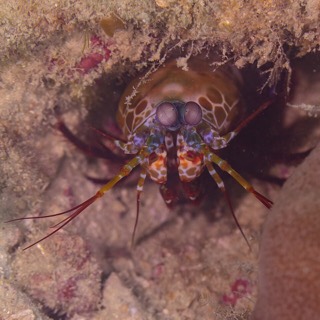 Peacock Mantis Shrimp (reference photo)
,_Zanz%C3%ADbar,_Tanzania,_2024-06-01,_DD_09.jpg)
Species Data
- Classification
- Stomatopoda / Odontodactylidae Source
- Size
- Body length about 3–18 cm (grows to a maximum of around 17 cm)
- Diet
- Carnivore Carnivorous, smashing open mollusks and crustaceans, shell and all, with its club-like raptorial appendages
- Activity
- Diurnal
- Distribution
- Native to Indo-Pacific coral reef seabeds from East Africa to Japan, Taiwan, New Caledonia and Australia, digging U-shaped burrows in sandy substrate at depths of 3–40 m. Source
- Sources
- ja.wikipedia.org en.wikipedia.org
Did You Know?
- Its raptorial appendage strikes at up to 80 km/h (50 mph)—among the fastest strikes in the animal kingdom—generating over 1,500 newtons of force and cavitation bubbles that deliver a second shockwave. Source
- Its compound eyes contain 12 types of photoreceptors (versus three in humans) and can detect circularly polarized light, a trait studied for optical technology. Source
Where to See This Species
Operating facilities registered on this site: Japan 1
Toba AquariumMieOpened in 1955
Source links to official sites, official YouTube channels, and news aggregators such as Zoo Ring. Visit the publisher for the full item.
Conservation Story
Conservation Status
Least Concern (LC)
Sources
Support Conservation
A visit is a small, positive way to support the daily lives of the animals you care about.
- Visit
- A visit itself helps support the facility.
- Animal Supporter Programs & Giving
- Find ways to support the facility through its official website.
- Furusato Nozei
- Municipally run facilities may share official guidance for this Japanese hometown-tax program.
FAQ
- Why is the peacock mantis shrimp's punch so famous?
- It snaps its club-like raptorial appendage at speeds up to 80 km/h, generating enough force—and cavitation bubbles—to shatter snail and clam shells, and even crack aquarium glass. Source
- How good is its eyesight?
- Each compound eye carries 12 types of photoreceptors, far more than the three humans have, allowing it to see ultraviolet and circularly polarized light. Source
- How many operating facilities are registered here?
- Operating facilities registered on this site: Japan 1 Source
Books & gear
Source: ja.wikipedia.org en.wikipedia.org