Père David's Deerシフゾウ
Elaphurus davidianusEW— Extinct in the Wild
Père David's deer is a wetland-adapted deer once native to the river valleys of China that went extinct in the wild by 1939. The entire species survived only through a captive herd established at England's Woburn Abbey, descended from animals sent to Europe before the extinction. Reintroduction to China began in 1985, and by 2020 the wild population had grown to an estimated 2,825 individuals, alongside thousands more in reserves — a rare conservation success story, though the IUCN still lists the species as Extinct in the Wild pending reassessment.
Operating facilities registered on this site: Japan 1 (Hiroshima City Asa Zoological Park). These facilities are confirmed by resident animal records or the facility’s official information.
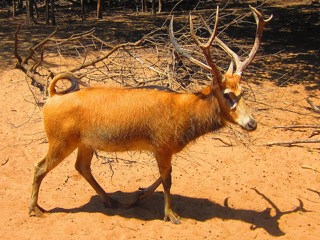 Père David's Deer (reference photo)

Species Data
- Classification
- Artiodactyla / Cervidae Source
- Size
- Shoulder height 122–137 cm, body length 183–216 cm
- Weight
- Males about 214 kg, females about 159 kg
- Lifespan
- Record of 23 years 3 months in captivity
- Diet
- Herbivore Herbivorous, feeding mainly on grasses, leaves, and aquatic plants
- Distribution
- Historically native to the subtropical river valleys of China; extinct in the wild but sustained today through reintroduction and captive breeding. Source
- Sources
- ja.wikipedia.org en.wikipedia.org
Did You Know?
- Its Chinese name, sibuxiang, means "four not alike," referring to features resembling a deer, a horse, a cow, and a donkey combined. Source
- Flooding and unrest around 1900 wiped out even the captive herds in China, but the lineage preserved at Woburn Abbey in England was reintroduced to China starting in 1985. Source
- Well adapted to wetlands, it is a strong swimmer able to submerge up to its shoulders and readily feeds on aquatic vegetation. Source
Where to See This Species
Operating facilities registered on this site: Japan 1
Hiroshima City Asa Zoological ParkHiroshimaFrom JR Hiroshima Station, take the Sanyo Main Line or Kabe Line to Shin-Hakushima Station, transfer to the Astram Line to Kamiyasu Station, then take a bus to "Asa Dobutsu Koen" (about 45 minutes in total).
Possible records, not yet confirmed: 2
These facilities are not confirmed by an official animal list. They appear in secondary sources such as Wikipedia; check the facility’s official website for current exhibits.
Kyoto City ZooKyotoOpened in 1903
(Not confirmed by official sources) Source
Conservation Story
Conservation Status
Extinct in the Wild (EW)
Sources
Support Conservation
A visit is a small, positive way to support the daily lives of the animals you care about.
- Visit
- A visit itself helps support the facility.
- Animal Supporter Programs & Giving
- Find ways to support the facility through its official website.
- Furusato Nozei
- Municipally run facilities may share official guidance for this Japanese hometown-tax program.
FAQ
- Where can I see Père David's Deer in Japan?
- Operating facilities registered on this site: Japan 1 (Hiroshima City Asa Zoological Park). These facilities are confirmed by resident animal records or the facility’s official information. Source
- Why is Père David's deer called 'four not alike' in Chinese?
- Its Chinese name, sibuxiang, reflects features that resemble four different animals: antlers like a deer, a neck like a camel or horse, hooves like a cow, and a tail like a donkey. Source
- Is Père David's deer extinct?
- It went extinct in the wild by 1939, but a captive herd preserved at Woburn Abbey in England saved the species, and reintroduction to China since 1985 has restored a wild population of over 2,800 animals as of 2020. Source
- Is Père David's deer a good swimmer?
- Yes. It is well adapted to wetlands, capable of swimming while submerged up to its shoulders and feeding readily on aquatic plants. Source
Books & gear
Source: ja.wikipedia.org en.wikipedia.org