Red Foxアカギツネ
Vulpes vulpesLC— Least Concern
The red fox is the largest and most widely distributed member of the genus Vulpes, ranging across nearly the entire Northern Hemisphere from North America to Eurasia and North Africa. An adaptable omnivore with acute hearing and a remarkable memory for cached food, it thrives in habitats from forests to cities. Listed as Least Concern by the IUCN, it includes numerous regional subspecies, including Japan's Hokkaido and Honshu red foxes.
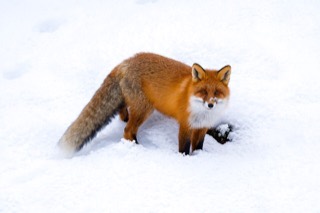 Red Fox (reference photo)

Species Data
- Classification
- Carnivora / Canidae Source
- Size
- Body length 45.5–90 cm, tail 30–56 cm, shoulder height 35–50 cm
- Weight
- 2.2–14 kg (varies greatly by region; females are 15–20% lighter than males)
- Lifespan
- Wild: average about 3 years / captive: records of about 12 years
- Diet
- Carnivore Carnivore with omnivorous tendencies, feeding mainly on rodents and rabbits as well as insects, fruit, earthworms, bird eggs, and other small animals; eats 0.5–1 kg a day
- Activity
- Mainly crepuscular, becoming more nocturnal in areas with artificial lighting
- Distribution
- Found across nearly the entire Northern Hemisphere—most of North America, Europe, Asia, and parts of North Africa—making it the most widely distributed member of the order Carnivora. It has also been introduced to Australia. Source
- Sources
- ja.wikipedia.org en.wikipedia.org
Did You Know?
- Red foxes cache surplus food by burying it and remember the locations with remarkable accuracy, successfully retrieving cached prey roughly 90% of the time the following day. Source
- Red foxes have extremely acute hearing and can detect the squeaking of mice from as far away as about 100 meters. Source
- A red fox can run at speeds of up to 50 km/h, and its vocal repertoire spans a range of roughly five octaves. Source
Where to See This Species
Operating facilities registered on this site: Japan 1
MiyagizaoukitsunemuraMiyagiFrom Tokyo, about 4 hours 45 minutes on the Tohoku Expressway from the Urawa IC to the Shiroishi IC, then about 20 minutes by car from the Shiroishi IC.
Source links to official sites, official YouTube channels, and news aggregators such as Zoo Ring. Visit the publisher for the full item.
Conservation Story
Conservation Status
Least Concern (LC)
Sources
Support Conservation
A visit is a small, positive way to support the daily lives of the animals you care about.
- Visit
- A visit itself helps support the facility.
- Animal Supporter Programs & Giving
- Find ways to support the facility through its official website.
- Furusato Nozei
- Municipally run facilities may share official guidance for this Japanese hometown-tax program.
FAQ
- How far can red foxes hear their prey?
- Red foxes have exceptionally sharp hearing and can detect a mouse squeaking from around 100 meters away, a key adaptation for hunting rodents hidden in grass or snow. Source
- What subspecies of red fox live in Japan?
- Japan is home to two subspecies: the Hokkaido red fox (kitakitsune) in Hokkaido and Sakhalin, and the Honshu red fox (hondogitsune) across Honshu, Shikoku, and Kyushu. Source
- Do red foxes remember where they bury food?
- Yes. Red foxes cache extra food and recall the hiding spots with striking precision, digging up a cached item successfully around 90% of the time the following day. Source
- How many operating facilities are registered here?
- Operating facilities registered on this site: Japan 1 Source
Books & gear
Source: ja.wikipedia.org en.wikipedia.org