Red Lionfishミノカサゴ
Pterois lunulataLC— Least Concern
The luna lionfish (Pterois lunulata), called minokasago in Japan, is a venomous scorpionfish found in the western Pacific from southern Japan and Korea south to Australia and New Caledonia, reaching up to about 35 cm. It hunts small fish, crustaceans, and other small animals at night, resting among reef crevices by day, and its dorsal spines carry venom potent enough to have caused human deaths. It is listed as Least Concern by the IUCN.
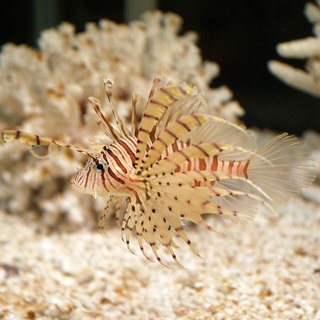 Red Lionfish (reference photo)

Species Data
- Classification
- Perciformes / Scorpaenidae Source
- Size
- Total length about 25–35 cm
- Diet
- Carnivore Carnivorous, preying on small animals such as mollusks, crustaceans, small fish, and annelids
- Activity
- Nocturnal (hides in the shadows of coral and rocks during the day)
- Distribution
- Found in the western Pacific from southern Japan and Korea south to Australia and New Caledonia, occurring over rocky reefs and, at times, soft-bottom substrates at depths of 132-172 m. Source
- Sources
- ja.wikipedia.org en.wikipedia.org
Did You Know?
- Its spines carry potent venom, with a reported LD50 of 1.1 mg/kg by intravenous injection, and human deaths have been recorded. Source
- In parts of Hiroshima Prefecture it is called "nanuka-bashiri" (seven-day runner), reflecting the belief that its sting causes pain lasting seven days. Source
- Despite its elegant swimming, it has an aggressive temperament that contrasts with its graceful appearance. Source
Where to See This Species
Operating facilities registered on this site: Japan 1
Murotohaikou SuizokukanKochiOpened in 2018
Source links to official sites, official YouTube channels, and news aggregators such as Zoo Ring. Visit the publisher for the full item.
Conservation Story
Conservation Status
Least Concern (LC)
Sources
Support Conservation
A visit is a small, positive way to support the daily lives of the animals you care about.
- Visit
- A visit itself helps support the facility.
- Animal Supporter Programs & Giving
- Find ways to support the facility through its official website.
- Furusato Nozei
- Municipally run facilities may share official guidance for this Japanese hometown-tax program.
FAQ
- Is the lionfish's sting dangerous?
- Yes; its spines carry potent venom (LD50 of 1.1 mg/kg by intravenous injection in test studies), and human deaths have been reported. Source
- What does the lionfish eat?
- It preys on small animals including mollusks, crustaceans, small fish, and marine worms. Source
- Is the lionfish active during the day or night?
- It is nocturnal, hiding among coral or rocky crevices during the day and hunting at night. Source
- How many operating facilities are registered here?
- Operating facilities registered on this site: Japan 1 Source
Books & gear
Source: ja.wikipedia.org en.wikipedia.org