Saltwater Crocodileイリエワニ
Crocodylus porosusLC— Least Concern
The saltwater crocodile is the largest living reptile, ranging from India's east coast across Southeast Asia to northern Australia and occasionally straying as far as southern Japan. Powerful swimmers that use ocean currents to travel long distances between rivers and islands, they possess the strongest bite force ever measured in a living animal and prey on an unusually broad range of species, from fish and birds to large mammals. Despite their fearsome reputation, populations in Australia have rebounded strongly since hunting bans in the 1970s, and the species is currently listed as Least Concern by the IUCN.
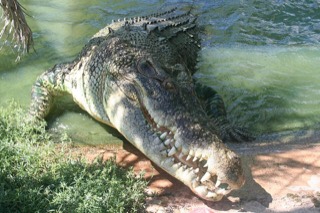 Saltwater Crocodile (reference photo)

Species Data
- Classification
- Crocodilia / Crocodylidae Source
- Size
- Males average 4–4.5 m in total length, with large individuals exceeding 6 m; females are smaller at about 2.7–3.1 m
- Weight
- Males average 200–1,100 kg, with large individuals reaching 2,000 kg; females 76–200 kg
- Lifespan
- Said to live over 70 years, and possibly over 100, though extreme age records are unverified
- Diet
- Carnivore Carnivorous, with the broadest diet of any living crocodilian, preying on fish, amphibians, reptiles, birds, mammals, and crustaceans
- Activity
- Generally sedentary, hunting mostly at night; sometimes uses ocean currents to travel long distances
- Distribution
- Ranges from India's east coast across Southeast Asia and the Sunda Islands to New Guinea and northern Australia, with occasional stray individuals recorded as far as southern Japan. Source
- Sources
- ja.wikipedia.org en.wikipedia.org
Did You Know?
- It has the strongest measured bite force of any living animal, recorded at 16,414 N, with the largest individuals potentially reaching 27,531 to 34,424 N. Source
- It is the largest living reptile and the largest of all crocodilians, exceeding every other crocodile, caiman, or alligator species in both length and weight. Source
- "Lolong," captured in the Philippines in September 2011, measured 6.17 m—the largest crocodile ever held in captivity—and was believed responsible for attacks that killed three local residents. Source
Where to See This Species
Operating facilities registered on this site: Japan 1
Conservation Story
Conservation Status
Least Concern (LC)
Sources
Support Conservation
A visit is a small, positive way to support the daily lives of the animals you care about.
- Visit
- A visit itself helps support the facility.
- Animal Supporter Programs & Giving
- Find ways to support the facility through its official website.
- Furusato Nozei
- Municipally run facilities may share official guidance for this Japanese hometown-tax program.
FAQ
- How big does a saltwater crocodile get?
- Males typically average 4 to 4.5 meters and can exceed 6 meters, weighing up to around 1,100 kg on average with the largest individuals reaching roughly 2,000 kg; it is the largest living reptile. Source
- How strong is a saltwater crocodile's bite?
- It has the strongest bite force ever measured in a living animal, recorded at 16,414 newtons, with estimates for the largest individuals potentially exceeding 27,000 newtons. Source
- Can saltwater crocodiles travel between islands?
- Yes. They are strong swimmers that ride ocean currents to cover long distances at sea, which explains occasional sightings far from their core range, including rare strays reaching southern Japan. Source
- How many operating facilities are registered here?
- Operating facilities registered on this site: Japan 1 Source
Books & gear
Source: ja.wikipedia.org en.wikipedia.org