Scimitar Oryxシロオリックス
Oryx dammahEW— Extinct in the Wild
The scimitar oryx is a desert antelope once widespread across North Africa's Sahara and Sahel, prized for its long, gracefully curved horns and remarkable ability to survive without drinking water for up to nine or ten months. Overhunting drove it to extinction in the wild by 2000, but a reintroduction program in Chad's Ouadi Rimé-Ouadi Achim Faunal Reserve has since rebuilt a wild population of several hundred animals, leading the IUCN to reclassify it from Extinct in the Wild to Endangered in 2023.
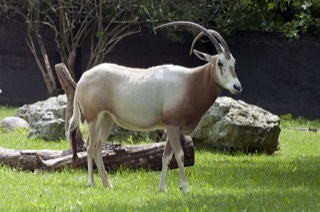 Scimitar Oryx (reference photo)

Species Data
- Classification
- Artiodactyla / Bovidae Source
- Size
- Body length about 140–240 cm, shoulder height 110–125 cm
- Weight
- Males 140–210 kg, females 91–140 kg
- Lifespan
- Wild: about 20 years (one captive individual lived to 21)
- Diet
- Herbivore Herbivorous, eating herbs, fruit, shrubs, succulents, and legumes; its kidneys limit water loss, allowing it to survive 9–10 months without drinking
- Activity
- Diurnal; rests in the shade or in hollows it digs itself during the heat of the day
- Distribution
- Historically ranged across the Sahara and Sahel regions of North Africa, but overhunting drove it to extinction in the wild by the late 1980s/1990s. Reintroduction efforts, most notably in Chad's Ouadi Rimé-Ouadi Achim Faunal Reserve, have since re-established a wild population. Source
- Sources
- ja.wikipedia.org en.wikipedia.org
Did You Know?
- Both sexes grow long, gracefully backward-curving horns that can reach 1.0 to 1.2 meters in length. Source
- Declared Extinct in the Wild in 2000, the species saw its first wild birth in over 20 years in early 2017 following reintroduction to Chad, and the wild population had grown to roughly 400 individuals by 2021, with 60 calves born that year alone. Source
- In 1968, Tokyo's Tama Zoological Park achieved Japan's first successful captive breeding of the scimitar oryx. Source
Where to See This Species
Operating facilities registered on this site: Japan 5
Adventure WorldWakayamaOpened in 1978
Noichi Zoological Park of Kochi PrefectureKochiA 20-minute walk or 13-minute rental-bicycle ride from Noichi Station on the Tosa Kuroshio Railway Gomen-Nahari Line.
Naganoshichausuyama DoubutsuenNaganoThe nearest station is JR Shinonoi Station.
TOBU ZOOSaitamaFrom Tobu-Dobutsu-Koen Station (west exit), about 10 minutes on foot (600 m) or about 5 minutes by bus.
Conservation Story
Conservation Status
Extinct in the Wild (EW)
Sources
Support Conservation
A visit is a small, positive way to support the daily lives of the animals you care about.
- Visit
- A visit itself helps support the facility.
- Animal Supporter Programs & Giving
- Find ways to support the facility through its official website.
- Furusato Nozei
- Municipally run facilities may share official guidance for this Japanese hometown-tax program.
FAQ
- Is the scimitar oryx extinct?
- It was declared Extinct in the Wild in 2000 after decades of overhunting, but a reintroduction program to Chad's Ouadi Rimé-Ouadi Achim Faunal Reserve has since rebuilt a wild population of roughly 400 animals as of 2021, and the IUCN reclassified it as Endangered in 2023. Source
- How do scimitar oryx survive without water?
- Their kidneys are adapted to minimize water loss through urination, allowing them to go without drinking for nine to ten months, relying instead on moisture from the plants they eat. Source
- How long are a scimitar oryx's horns?
- Both males and females grow long, backward-curving horns that can reach around 1.0 to 1.2 meters in length. Source
- How many operating facilities are registered here?
- Operating facilities registered on this site: Japan 5 Source
Books & gear
Source: ja.wikipedia.org en.wikipedia.org