Servalサーバル
Leptailurus servalLC— Least Concern
The serval is a slender, long-legged wild cat of sub-Saharan Africa's grasslands and wetlands, instantly recognizable by its oversized ears and spotted golden coat. It is one of the most successful hunters among cats, using acute hearing to pinpoint rodents in tall grass and explosive vertical leaps to snatch birds from the air. Classified as Least Concern by the IUCN, it remains widespread across most of its range despite having nearly disappeared from North Africa.
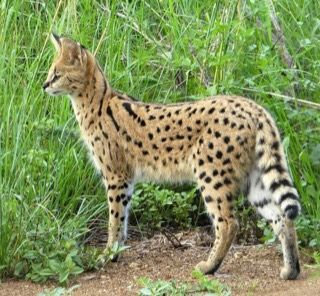 Serval (reference photo)

Species Data
- Classification
- Carnivora / Felidae Source
- Size
- Head-body length: males 59–92 cm, females 63–82 cm; tail 20–38 cm
- Weight
- Males 7.9–18 kg, females 6–12.5 kg
- Lifespan
- Wild: up to 11 years / captive: records of 20–22 years
- Diet
- Carnivore Carnivorous; small mammals, chiefly rodents, are the staple (80–97% of the diet), supplemented by birds, eggs, reptiles, frogs, and fish, and occasionally the young of small antelopes
- Activity
- Active both day and night, but tends to be most active in early morning, at dusk, and late at night
- Distribution
- Found across sub-Saharan Africa in grasslands, wetlands, and bamboo thickets. In North Africa it persists only in Morocco and in a reintroduced population in Tunisia. Source
- Sources
- ja.wikipedia.org en.wikipedia.org
Did You Know?
- Relative to its body size, the serval has exceptionally long legs, allowing vertical leaps of over 2 meters and horizontal jumps of up to 3.6 meters—sometimes used to snatch birds out of the air. Source
- The serval's large, closely set ears can rotate up to 180 degrees independently, giving it exceptional hearing to pinpoint prey hidden in tall grass. Source
- Servals succeed in roughly half of their hunting attempts, with mothers achieving success rates as high as 62% and averaging 15–16 kills a day, among the highest hunting success rates recorded for any cat. Source
Where to See This Species
Operating facilities registered on this site: Japan 3
Adventure WorldWakayamaOpened in 1978
Fukuyama Shiritsu DoubutsuenHiroshimaThere is no public transportation; access is by car.
Higashiyama Zoo and Botanical GardensAichiOpened in 1937
Former facilities
North Safari SapporoHokkaidoOpened in 2005
Closed: 2025-09-30 Official Site
Source links to official sites, official YouTube channels, and news aggregators such as Zoo Ring. Visit the publisher for the full item.
Conservation Story
Conservation Status
Least Concern (LC)
Sources
Support Conservation
A visit is a small, positive way to support the daily lives of the animals you care about.
- Visit
- A visit itself helps support the facility.
- Animal Supporter Programs & Giving
- Find ways to support the facility through its official website.
- Furusato Nozei
- Municipally run facilities may share official guidance for this Japanese hometown-tax program.
FAQ
- How high can a serval jump?
- A serval can leap more than 2 meters vertically and up to 3.6 meters horizontally, using its exceptionally long legs to pounce on prey or even snatch birds out of the air. Source
- Why does the serval have such large ears?
- Its large, independently rotating ears—which can turn up to 180 degrees—give it exceptional hearing, allowing it to precisely locate rodents and other prey hidden in tall grass. Source
- How successful are servals at hunting?
- Servals succeed in about half of their hunting attempts, with mothers reaching success rates of 62% and averaging 15–16 kills per day, among the highest hunting success rates of any cat species. Source
- How many operating facilities are registered here?
- Operating facilities registered on this site: Japan 3 Source
Books & gear
Source: ja.wikipedia.org en.wikipedia.org