Spotted Hyenaブチハイエナ
Crocuta crocutaLC— Least Concern
The spotted hyena is the largest member of the hyena family, found across most of sub-Saharan Africa. Unlike its reputation as a mere scavenger, it is primarily an active hunter, taking over half its food through predation on ungulates such as wildebeest and zebra. It lives in large, female-dominated clans and is classified as Least Concern by the IUCN.
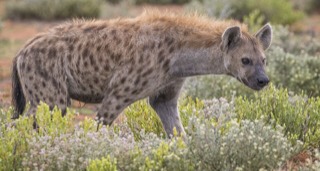 Spotted Hyena (reference photo)
.jpg)
Species Data
- Classification
- Carnivora / Hyaenidae Source
- Size
- Body length 95–165 cm
- Weight
- About 40–86 kg (the largest hyena species)
- Lifespan
- Wild: up to 33 years / captive: over 40 years
- Diet
- Carnivore Prey it kills itself makes up more than 60% of its food; feeds mainly on mammals over 20 kg, and also eats birds, reptiles, fish, insects, and carrion
- Activity
- Nocturnal
- Distribution
- The spotted hyena is found across most of sub-Saharan Africa, though it is absent from the Sahara Desert, the Congo Basin rainforest, and the southernmost tip of the continent. Source
- Sources
- ja.wikipedia.org en.wikipedia.org
Did You Know?
- Spotted hyenas are thought to use at least a dozen distinct vocalizations, and their laugh-like call is the source of the English nickname "laughing hyena." Source
- Females are larger than males, and clans of dozens of individuals are organized around a female-dominated hierarchy. Source
- Female spotted hyenas have an unusually enlarged, penis-like clitoris, a trait unique among placental mammals, which makes giving birth especially difficult and risky, particularly for first-time mothers. Source
Where to See This Species
Operating facilities registered on this site: Japan 6
Utsunomiya DoubutsuenTochigiAbout 5 minutes from the Utsunomiya IC on the Tohoku Expressway; free parking for 1,000 cars.
African safariOitaBy car, the park is about 6 km (about 7 minutes) from the Beppu-wan Smart IC.
Noichi Zoological Park of Kochi PrefectureKochiA 20-minute walk or 13-minute rental-bicycle ride from Noichi Station on the Tosa Kuroshio Railway Gomen-Nahari Line.
Sapporoshimaruyama DoubutsuenHokkaidoOpened in 1951
Chiba Zoological ParkChibaOpened in 1985
Tennoji ZooOsakaOpened in 1915
Former facilities
North Safari SapporoHokkaidoOpened in 2005
Closed: 2025-09-30 Official Site
- 9月25日(金) からブチハイエナ「エサンドワ」の展示を再開します
- お誕生日にシカ肉をあげたよ🍖#池田動物園 #岡山 #ブチハイエナ
- タカの渡りを観察しよう
- 9月17日(木)からブチハイエナ「エサンドワ」の展示を休止します
- ブチハイエナ「カロア」の展示再開について
- ブチハイエナ「カロア」について
Source links to official sites, official YouTube channels, and news aggregators such as Zoo Ring. Visit the publisher for the full item.
Conservation Story
Conservation Status
Least Concern (LC)
Sources
Support Conservation
A visit is a small, positive way to support the daily lives of the animals you care about.
- Visit
- A visit itself helps support the facility.
- Animal Supporter Programs & Giving
- Find ways to support the facility through its official website.
- Furusato Nozei
- Municipally run facilities may share official guidance for this Japanese hometown-tax program.
FAQ
- Do spotted hyenas hunt or just scavenge?
- They are primarily hunters — more than half of their food comes from prey they kill themselves, particularly medium to large ungulates, though they will also scavenge carcasses. Source
- Why are spotted hyenas called laughing hyenas?
- They produce a distinctive, laugh-like vocalization among the roughly dozen different calls they use, which is the origin of the nickname. Source
- Are female spotted hyenas dominant over males?
- Yes, females are larger than males and clans are organized around a matriarchal hierarchy in which females hold the top ranks. Source
- How many operating facilities are registered here?
- Operating facilities registered on this site: Japan 6 Source
Books & gear
Source: ja.wikipedia.org en.wikipedia.org