Sword-tail Newtシリケンイモリ
Cynops ensicaudaVU— Vulnerable
The sword-tail newt is a large, semi-aquatic newt endemic to the Ryukyu Archipelago of southern Japan, including the Amami and Okinawa island groups. Females can reach up to 18 cm, the largest size in its genus, and it inhabits humid forests, ponds, and slow-moving streams, foraging mainly at night on small invertebrates. Listed as Vulnerable by the IUCN, its populations have declined sharply in recent decades.
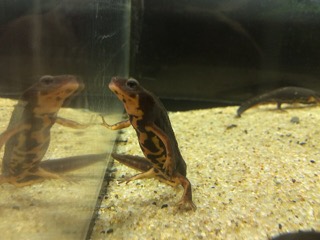 Sword-tail Newt (reference photo)

Species Data
- Classification
- Caudata / Salamandridae Source
- Size
- Males about 14 cm in total length (snout-vent length 4.6–7.5 cm), females about 18 cm (snout-vent length 5.2–8.5 cm); females are among the largest in the genus Cynops
- Lifespan
- A captive record of over 36 years exists (for the Okinawa sword-tail newt)
- Diet
- Carnivore In the wild, preys on small invertebrates such as mosquito larvae, earthworms, and snails
- Activity
- Nocturnal and crepuscular; hides under cover by day and becomes active from evening into the night to forage
- Distribution
- Endemic to the Ryukyu Archipelago of southern Japan, including the Amami and Okinawa island groups, inhabiting humid forests, ponds, and slow-moving streams. Source
Did You Know?
- During the breeding season, the male's tail becomes vertically broader, and the species lays eggs both underwater and on land in slow-moving water bodies, ponds, and wetlands. Source
- Females can reach up to 18 cm in total length, making the species the largest living member of the genus Cynops. Source
- As of 2010, newt counts at breeding grounds in Okinawa were reported to be 75% lower than in 1996, and some individuals fall into concrete roadside drainage ditches on rainy days and cannot escape. Source
Where to See This Species
Operating facilities registered on this site: Japan 1
Okinawa Churaumi AquariumOkinawaOpened in 2002
Source links to official sites, official YouTube channels, and news aggregators such as Zoo Ring. Visit the publisher for the full item.
Conservation Story
Conservation Status
Vulnerable (VU)
Sources
Support Conservation
A visit is a small, positive way to support the daily lives of the animals you care about.
- Visit
- A visit itself helps support the facility.
- Animal Supporter Programs & Giving
- Find ways to support the facility through its official website.
- Furusato Nozei
- Municipally run facilities may share official guidance for this Japanese hometown-tax program.
FAQ
- How big does the sword-tail newt get?
- Females can reach up to about 18 cm in total length, making it the largest living species in its genus, while males are somewhat smaller. Source
- Where does the sword-tail newt live?
- It is endemic to the Ryukyu Archipelago of southern Japan, including the Amami and Okinawa island groups, living in humid forests, ponds, and slow-moving streams. Source
- Is the sword-tail newt endangered?
- Yes, it is listed as Vulnerable by the IUCN. In Okinawa, breeding-ground counts fell by 75% between 1996 and 2010. Source
- How many operating facilities are registered here?
- Operating facilities registered on this site: Japan 1 Source
Books & gear
Source: ja.wikipedia.org en.wikipedia.org