African Grey Parrotヨウム
Psittacus erithacusEN— Endangered
The grey parrot, widely known in aviculture as the African grey, is a highly intelligent parrot native to the forests of equatorial Africa. Famous for its exceptional ability to mimic human speech and understand meaning rather than merely repeat sounds, it forms large, social flocks and communal roosts in the wild. Once common but now heavily targeted for the pet trade, it is listed as Endangered by the IUCN.
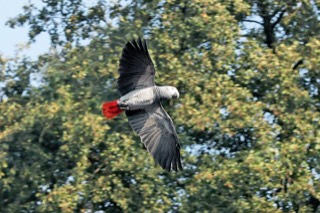 African Grey Parrot (reference photo)

Species Data
- Classification
- Psittaciformes / Psittacidae Source
- Size
- Body length about 28–39 cm
- Weight
- About 400–500 g
- Lifespan
- Wild: average about 23 years / captive: 40–60 years, and said to approach 100 years under good conditions
- Diet
- Herbivore Feeds mainly on seeds and fruit (especially oil palm fruit); in captivity it is also given pellets. Sometimes eats flowers, bark, insects, and snails
- Activity
- Diurnal; forms large flocks and gathers communally at roosts at night
- Distribution
- The grey parrot is native to equatorial Africa, ranging from Ivory Coast and Ghana through the Lake Victoria region to Angola and the Democratic Republic of Congo. Source
- Sources
- ja.wikipedia.org en.wikipedia.org
Did You Know?
- Research has shown that grey parrots can understand the meaning of human words rather than simply mimicking them, enabling genuine two-way communication, with cognitive abilities compared to a four- to six-year-old child. Source
- Wild individuals have been recorded using over 200 different calls, including imitations of other bird species. Source
- It can form massive communal roosts of over 5,000 individuals, reflecting its strongly social nature. Source
Where to See This Species
Operating facilities registered on this site: Japan 1
Wan Park Kouchianimaru LandKochiAddress: 6-9-1 Sanbashi-dori, Kochi (inside Wanpark Kochi).
Source links to official sites, official YouTube channels, and news aggregators such as Zoo Ring. Visit the publisher for the full item.
Conservation Story
Conservation Status
Endangered (EN)
Sources
Support Conservation
A visit is a small, positive way to support the daily lives of the animals you care about.
- Visit
- A visit itself helps support the facility.
- Animal Supporter Programs & Giving
- Find ways to support the facility through its official website.
- Furusato Nozei
- Municipally run facilities may share official guidance for this Japanese hometown-tax program.
FAQ
- How intelligent are grey parrots?
- They are considered among the most cognitively advanced parrots, with studies showing abilities comparable to a four- to six-year-old human child, including genuine comprehension of words rather than simple mimicry. Source
- How long do grey parrots live?
- In the wild they live around 23 years on average, but in captivity with good care they commonly live 40 to 60 years and are sometimes reported to reach nearly a century. Source
- Why is the grey parrot endangered?
- Heavy capture for the international pet trade, combined with habitat loss, has driven sharp population declines, leading the IUCN to list it as Endangered and CITES to move it to Appendix I in 2016. Source
- How many operating facilities are registered here?
- Operating facilities registered on this site: Japan 1 Source
Books & gear
Source: ja.wikipedia.org en.wikipedia.org