Alpacaアルパカ
Vicugna pacosNE— Not Evaluated
The alpaca is a domesticated camelid from the high Andes of Peru, Bolivia, Ecuador, and Chile, bred from the wild vicuña thousands of years ago primarily for its soft fleece. It is a docile grazer with a three-chambered stomach suited to sparse mountain vegetation and can live 15 to 20 years. As a domestic species it is not evaluated by the IUCN, though its wild ancestor, the vicuña, is listed as Least Concern.
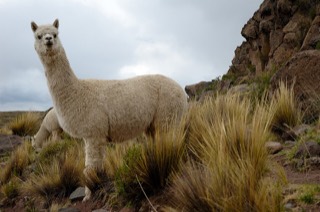 Alpaca (reference photo)
.jpg)
Species Data
- Classification
- Artiodactyla / Camelidae Source
- Size
- Height about 81–99 cm (at the shoulder)
- Weight
- About 48–90 kg
- Lifespan
- Captive: average 15–20 years, record 28 years
- Diet
- Herbivore Herbivorous, feeding mainly on pasture grass and hay; eats about 1.5% of its body weight a day, and its specialized three-chambered stomach extracts nutrients efficiently from low-quality plants
- Distribution
- The alpaca is indigenous to the Andes Mountains of Peru, Bolivia, Ecuador, and Chile at elevations of 3,500 to 5,000 meters, and was domesticated from the wild vicuña thousands of years ago. It is now raised on farms worldwide. Source
- Sources
- ja.wikipedia.org en.wikipedia.org
Did You Know?
- When threatened, alpacas can spit up to ten feet (about three meters). The spit often includes regurgitated, partially digested stomach contents and has a strong smell. Source
- An alpaca's fleece keeps growing if left unshorn, reaching the ground in about two years — one reason regular shearing is essential both for the animal's welfare and for fiber production. Source
- There are two main breeds: the crimped-fleece Huacaya, which makes up about 90% of the population, and the straight-locked Suri, about 10%. Each animal yields roughly 2.3 to 4.5 kg of fiber per year. Source
Where to See This Species
Operating facilities registered on this site: Japan 10
NasudoubutsuoukokuTochigiAbout 50 minutes by car from Nasu-Shiobara Station on the Tohoku Shinkansen (a free shuttle bus is available; online reservation required by 17:00 the day before).
TOBU ZOOSaitamaFrom Tobu-Dobutsu-Koen Station (west exit), about 10 minutes on foot (600 m) or about 5 minutes by bus.
Kushiroshi DoubutsuenHokkaidoAbout 55 minutes from JR Kushiro Station by Akan Bus, or about 27 minutes (18 km) by car, taxi, or rental car.
Adventure WorldWakayamaOpened in 1978
Ishikawa DoubutsuenIshikawaAbout 60 minutes from the Kanazawa-Morimoto Interchange on the Hokuriku Expressway, about 40 minutes from the Kanazawa-Nishi Interchange, and about 20 minutes from the Komatsu Interchange.
Gokatsuraike Animal ParkMieAbout 10 minutes from the Seiwa-Taki Interchange.
Naganoshichausuyama DoubutsuenNaganoThe nearest station is JR Shinonoi Station.
Iida Shiritsu DoubutsuenNaganoAddress: 33 Ogimachi, Iida, Nagano.
Higashiyama Zoo and Botanical GardensAichiOpened in 1937
Former facilities
North Safari SapporoHokkaidoOpened in 2005
Closed: 2025-09-30 Official Site
Temporarily closed facilities
Satsukiyama DAYZOOOsakaOpened in 1957
Temporarily closed Official Site
Source links to official sites, official YouTube channels, and news aggregators such as Zoo Ring. Visit the publisher for the full item.
Conservation Story
Conservation Status
Not Evaluated (NE)
Sources
Support Conservation
A visit is a small, positive way to support the daily lives of the animals you care about.
- Visit
- A visit itself helps support the facility.
- Animal Supporter Programs & Giving
- Find ways to support the facility through its official website.
- Furusato Nozei
- Municipally run facilities may share official guidance for this Japanese hometown-tax program.
FAQ
- Are alpacas wild animals?
- No, alpacas are fully domesticated animals, bred from the wild vicuña in the Andes thousands of years ago. They are not evaluated on the IUCN Red List because domestic species fall outside its scope. Source
- Why do alpacas spit?
- Alpacas spit, sometimes up to three meters, mainly to establish dominance within a herd or to reject unwanted mating attempts. The spit often contains regurgitated stomach contents and has a strong odor. Source
- What are the two types of alpaca?
- Huacaya alpacas, with dense, crimped fleece, make up about 90% of the population, while Suri alpacas, with long, straight locks, make up about 10%. Source
- How many operating facilities are registered here?
- Operating facilities registered on this site: Japan 10 Source
Books & gear
Source: www.nasu-oukoku.com www.tobuzoo.com www.city.kushiro.lg.jp www.iucnredlist.org