Banded Archerfishテッポウウオ
Toxotes jaculatrixLC— Least Concern
The banded archerfish is an Indo-Pacific species famous for its sharpshooting hunting technique, spitting precisely aimed jets of water to knock insects off overhanging leaves. Living in brackish mangrove estuaries from India to the Solomon Islands, it compensates for light refraction when aiming and can strike prey more than two meters away.
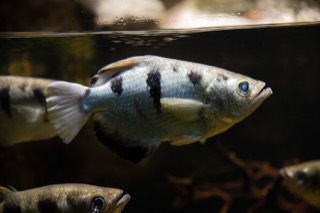 Banded Archerfish (reference photo)

Species Data
- Classification
- Carangiformes / Toxotidae Source
- Size
- Total length about 20–25 cm, maximum 30 cm
- Lifespan
- 5–8 years in captivity, up to 9–10 years
- Diet
- Omnivore Omnivorous; shoots down insects perched on leaves above the water with a jet of water, and also eats small fish and crustaceans near the surface
- Distribution
- Widely distributed across the Indo-Pacific from India east to the Solomon Islands and Vanuatu, inhabiting brackish mangrove estuaries and occasionally freshwater rivers. Source
- Sources
- ja.wikipedia.org en.wikipedia.org
Did You Know?
- It fires jets of water from just below the surface while compensating for light refraction, and large individuals can hit prey 2 to 3 meters away. Source
- It can reach prey it has knocked into the water within just 50 milliseconds of impact, demonstrating remarkably fast reaction speed. Source
- It hunts in groups and appears to learn by observing the shooting behavior of other individuals; a single spawning event can produce 20,000 to 150,000 eggs, though breeding rarely occurs in captivity. Source
Where to See This Species
Operating facilities registered on this site: Japan 16
NOTOJIMA AQUARIUMIshikawaThe nearest station is Wakura-Onsen Station.
Aquamarine FukushimaFukushimaOpened in 2000
Miyajima Public AquariumHiroshimaOpened in 2011
SENDAI UMINO-MORI AQUARIUMMiyagiOpened in 2015
Sunshine AquariumTokyoFrom Ikebukuro Station (Exit 35), walk along Sunshine 60 Street.
SHINAGAWA AQUARIUMTokyoOpened in 1991
Ise Sea ParadiseMieOpened in 1966
Yokohama Hakkeijima Sea ParadiseKanagawaThe nearest station is Hakkeijima Station on the Seaside Line (connecting from Kanazawa-Hakkei Station on the Keikyu Line or Shin-Sugita Station on the JR Negishi Line).
Okinawa Churaumi AquariumOkinawaOpened in 2002
Adachi Park of Living ThingsTokyoAbout 20 minutes on foot from the east exit of Takenotsuka Station on the Tobu Skytree Line.
Minamichitabichi LandAichiOpened in 1980
Hakone-en AquariumKanagawa
ItabashikuritsunettaikankyoushokubutsukanTokyoOpened in 1994
Port of Nagoya Public AquariumAichi5 minutes on foot from Exit 3 of Nagoyako Station on the Subway Meiko Line (transfer to the Meiko Line at Sakae Station on the Higashiyama Line, or at Kanayama Station on the Meitetsu and JR lines).
Tateshina Amusement AquariumNaganoOpened in 1993
Former facilities
Toukaidaigakukaiyoukagaku HakubutsukanShizuokaOpened in 1970
Closed: 2024-10-31 Official Site
Temporarily closed facilities
Shinyashima SuizokukanKagawaOpened in 1969
Temporarily closed Official Site
Conservation Story
Conservation Status
Least Concern (LC)
Sources
Support Conservation
A visit is a small, positive way to support the daily lives of the animals you care about.
- Visit
- A visit itself helps support the facility.
- Animal Supporter Programs & Giving
- Find ways to support the facility through its official website.
- Furusato Nozei
- Municipally run facilities may share official guidance for this Japanese hometown-tax program.
- Support NOTOJIMA AQUARIUM
- Support Aquamarine Fukushima
- Support Miyajima Public Aquarium
- Support SENDAI UMINO-MORI AQUARIUM
- Support NIFREL
- Support Sunshine Aquarium
- Support SHINAGAWA AQUARIUM
- Support Ise Sea Paradise
- Support Yokohama Hakkeijima Sea Paradise
- Support Okinawa Churaumi Aquarium
- Support Adachi Park of Living Things
- Support Minamichitabichi Land
- Support Hakone-en Aquarium
- Support Itabashikuritsunettaikankyoushokubutsukan
- Support Port of Nagoya Public Aquarium
- Support Tateshina Amusement Aquarium
FAQ
- How does the banded archerfish hunt?
- It positions itself just below the water's surface and shoots a precisely aimed jet of water at insects resting on overhanging leaves, knocking them into the water before rushing in to eat them, sometimes within 50 milliseconds of impact. Source
- Where does the banded archerfish live?
- It inhabits brackish mangrove estuaries and occasionally freshwater rivers across the Indo-Pacific, from India eastward to the Solomon Islands and Vanuatu. Source
- How many operating facilities are registered here?
- Operating facilities registered on this site: Japan 16 Source
Books & gear
Source: ja.wikipedia.org en.wikipedia.org