Clown Anemonefishカクレクマノミ
Amphiprion ocellarisLC— Least Concern
The ocellaris clownfish, often simply called the clownfish, is a small orange-and-white reef fish famous for its symbiotic partnership with sea anemones, whose stinging tentacles it is immune to. Native to the eastern Indian Ocean and western Pacific including Japan, it lives in strict size-based social groups where the largest fish is always female, and captive-bred individuals can live well over a decade.
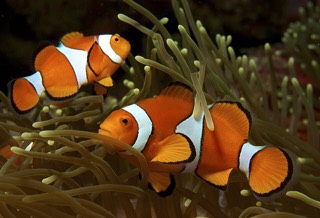 Clown Anemonefish (reference photo)
_by_Nick_Hobgood.jpg)
Species Data
- Classification
- Blenniiformes / Pomacentridae Source
- Size
- About 2 cm as a juvenile, about 8–11 cm as an adult
- Lifespan
- Estimated at 6–10 years in the wild; 10–15 years is typical in captivity, with records of individuals surviving and spawning beyond 20 years
- Diet
- Omnivore Omnivorous, eating leftovers from its host anemone as well as algae and zooplankton such as copepods
- Distribution
- Found across the eastern Indian Ocean and western Pacific, including Hawaii, northern Australia, Southeast Asia, and Japan, inhabiting outer reef slopes and sheltered lagoons down to about 15 meters. Source
Did You Know?
- Within a group, the largest individual becomes female and the second-largest becomes the breeding male, while the rest remain sexually immature, forming a strict size-based social hierarchy. Source
- It has evolved resistance to the stinging cells on sea anemone tentacles, allowing it to live safely among them for shelter and leftover food. Source
Where to See This Species
Operating facilities registered on this site: Japan 4
Sunshine AquariumTokyoFrom Ikebukuro Station (Exit 35), walk along Sunshine 60 Street.
NOTOJIMA AQUARIUMIshikawaThe nearest station is Wakura-Onsen Station.
Kyoto AquariumKyotoAbout a 15-minute walk from the central exit of JR Kyoto Station.
Kiryuugaoka DoubutsuenGunmaIf driving, set your car navigation to "Kiryugaoka Amusement Park" (Kiryugaoka Yuenchi) rather than "Kiryugaoka Zoo" to reach the parking lot (searching by the zoo name may give an incorrect route).
Former facilities
Toukaidaigakukaiyoukagaku HakubutsukanShizuokaOpened in 1970
Closed: 2024-10-31 Official Site
Source links to official sites, official YouTube channels, and news aggregators such as Zoo Ring. Visit the publisher for the full item.
Conservation Story
Conservation Status
Least Concern (LC)
Sources
Support Conservation
A visit is a small, positive way to support the daily lives of the animals you care about.
- Visit
- A visit itself helps support the facility.
- Animal Supporter Programs & Giving
- Find ways to support the facility through its official website.
- Furusato Nozei
- Municipally run facilities may share official guidance for this Japanese hometown-tax program.
FAQ
- How does the clownfish survive living among a sea anemone's stinging tentacles?
- It has evolved a resistance to the anemone's stinging cells, allowing it to shelter among the tentacles for protection from predators while also feeding on leftover scraps. Source
- Do all clownfish start out as males?
- Yes. All ocellaris clownfish are born male, and within each social group the single largest individual changes sex to become the breeding female. Source
- How many operating facilities are registered here?
- Operating facilities registered on this site: Japan 4 Source
Books & gear
Source: ja.wikipedia.org en.wikipedia.org