Common Elandエランド
Taurotragus oryxLC— Least Concern
The common eland is one of the largest antelope species in the world, ranging across the savannas and woodlands of East and Southern Africa. A browsing herbivore, it feeds mainly on leaves and shoots and can tolerate dry conditions by letting its body temperature rise and fall, camel-like, to conserve water. With a wide range across 15 African countries, the IUCN classifies it as Least Concern.
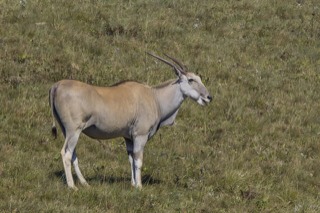 Common Eland (reference photo)
_Malolotja_2.jpg)
Species Data
- Classification
- Cetartiodactyla / Bovidae Source
- Size
- Head-body length: males about 240–345 cm; shoulder height: males about 151–183 cm, females about 125–153 cm
- Weight
- Males about 450–942 kg, females about 317–470 kg
- Lifespan
- Average 15–20 years; may reach 25 years in captivity
- Diet
- Herbivore Browser feeding mainly on leaves and branches; also eats grass, though not as a staple, and sometimes digs up roots
- Activity
- Basically diurnal, but limits activity during the heat of the day
- Distribution
- The common eland is native to 15 African countries across East and Southern Africa, from Ethiopia and South Sudan southward through Tanzania, Kenya, Zambia, Zimbabwe, Botswana, Namibia, and South Africa. Source
- Sources
- ja.wikipedia.org en.wikipedia.org
Did You Know?
- Like camels, common elands can let their body temperature drop by up to 7°C to reduce water loss through evaporation, an adaptation to dry habitats. Source
- The name 'eland' comes from the Dutch word for 'elk,' given by Dutch settlers in South Africa who likened this large antelope to the elk they knew from Europe. Source
- Common elands can jump up to 2.5 m from a standing position, with young individuals reaching as high as 3 m. Source
Where to See This Species
Operating facilities registered on this site: Japan 9
Adventure WorldWakayamaOpened in 1978
Ishikawa DoubutsuenIshikawaAbout 60 minutes from the Kanazawa-Morimoto Interchange on the Hokuriku Expressway, about 40 minutes from the Kanazawa-Nishi Interchange, and about 20 minutes from the Komatsu Interchange.
Yokohama Shiritsu Yokohama DoubutsuenKanagawaOpened in 1999
Hiroshima City Asa Zoological ParkHiroshimaFrom JR Hiroshima Station, take the Sanyo Main Line or Kabe Line to Shin-Hakushima Station, transfer to the Astram Line to Kamiyasu Station, then take a bus to "Asa Dobutsu Koen" (about 45 minutes in total).
Tennoji ZooOsakaOpened in 1915
TOBU ZOOSaitamaFrom Tobu-Dobutsu-Koen Station (west exit), about 10 minutes on foot (600 m) or about 5 minutes by bus.
Nasu SafariParkTochigiAbout 15 minutes from the Nasu IC or about 25 minutes from the Kuroiso-Itamuro IC on the Tohoku Expressway.
Fuji Safari ParkShizuokaOpened in 1980
Higashiyama Zoo and Botanical GardensAichiOpened in 1937
Source links to official sites, official YouTube channels, and news aggregators such as Zoo Ring. Visit the publisher for the full item.
Conservation Story
Conservation Status
Least Concern (LC)
Sources
Support Conservation
A visit is a small, positive way to support the daily lives of the animals you care about.
- Visit
- A visit itself helps support the facility.
- Animal Supporter Programs & Giving
- Find ways to support the facility through its official website.
- Furusato Nozei
- Municipally run facilities may share official guidance for this Japanese hometown-tax program.
FAQ
- How big is a common eland?
- It is one of the largest antelope species, with males reaching a body length of about 240 to 345 cm and weighing up to 942 kg, while females are notably smaller at around 317 to 470 kg. Source
- How does the common eland survive hot, dry climates?
- It can let its body temperature fluctuate by up to 7°C, similar to a camel, which reduces water loss through sweating and evaporation. Source
- Where does the name 'eland' come from?
- It derives from the Dutch word for 'elk.' Dutch settlers in South Africa named the antelope after the elk they were familiar with in Europe. Source
- How many operating facilities are registered here?
- Operating facilities registered on this site: Japan 9 Source
Books & gear
Source: ja.wikipedia.org en.wikipedia.org