Feather Starウミシダ
Comatula pectinataNE— Not Evaluated
Feather stars like Comatula pectinata are crinoids that cling to reefs and the seabed with grasping cirri, unfurling feathery, plankton-catching arms that regenerate with remarkable vigor — sometimes growing back in greater numbers — when damaged.
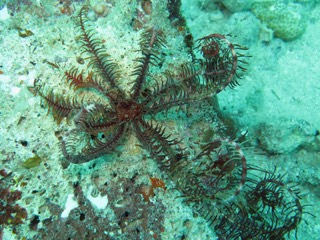 Feather Star (reference photo)

Species Data
- Classification
- Comatulida / Comatulidae Source
- Size
- Typically has around 10 arms, though the number can increase when regenerating from damage
- Diet
- Filter feeder Suspension feeder that spreads its feathery arms to capture zooplankton and other suspended particles with its tube feet and carries them to the mouth by ciliary action
- Distribution
- Found from Indonesia, the South China Sea, Vietnam, the Philippines, and Papua New Guinea to Okinawa, Western Australia, New South Wales, and New Caledonia, at depths of 0-93 m on reefs and the seabed. Source
- Sources
- en.wikipedia.org
Did You Know?
- While the larvae are bilaterally symmetrical, they transform into adults with the five-fold radial symmetry typical of echinoderms. Source
- Feather stars regenerate lost arms with remarkable vigor — when damaged, at least two new arms can grow in place of one, and in one documented case a 20 cm arm fully regrew within nine months. Source
Where to See This Species
Operating facilities registered on this site: Japan 2
Kagoshima City AquariumKagoshimaFrom Kagoshima-Chuo Station, take the tram (Route 2) to the Suizokukan-guchi stop and walk 8 minutes.
Shirahama Aquarium, Kyoto UniversityWakayamaOpened in 1930
Source links to official sites, official YouTube channels, and news aggregators such as Zoo Ring. Visit the publisher for the full item.
Conservation Story
Conservation Status
Not Evaluated (NE)
Sources
Support Conservation
A visit is a small, positive way to support the daily lives of the animals you care about.
- Visit
- A visit itself helps support the facility.
- Animal Supporter Programs & Giving
- Find ways to support the facility through its official website.
- Furusato Nozei
- Municipally run facilities may share official guidance for this Japanese hometown-tax program.
FAQ
- What does a feather star eat?
- It is a suspension feeder, extending its feathery arms into the current to catch plankton and organic particles with its tube feet, then passing the food to its mouth via ciliated grooves. Source
- Can a feather star regrow a lost arm?
- Yes, feather stars regenerate damaged arms readily, and can even end up with more arms than they started with after an injury. Source
- Where is Comatula pectinata found?
- It ranges across the western Pacific and eastern Indian Ocean, from Indonesia and the Philippines to Okinawa, Western Australia, and New Caledonia, at depths from the shallows to about 93 m. Source
- How many operating facilities are registered here?
- Operating facilities registered on this site: Japan 2 Source
Books & gear
Source: ja.wikipedia.org en.wikipedia.org