Golden Eagleイヌワシ

Aquila chrysaetosLC— Least Concern

The golden eagle is one of the largest and most powerful birds of prey in the Northern Hemisphere, ranging across Eurasia and North America. A formidable hunter of hares, ground squirrels, and other mammals, it can reach diving speeds of up to 320 km/h, among the fastest of any living animal.

Operating facilities registered on this site: Japan 4 (Morioka Zoo, Chiba Zoological Park, Tama Zoo, and 1 more). These facilities are confirmed by resident animal records or the facility’s official information.
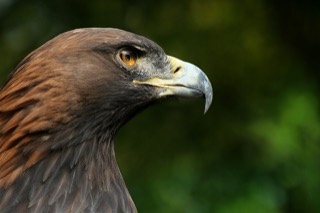
Golden Eagle (reference photo)
Photo: Richard Bartz, Munich aka Makro Freak / CC BY-SA 2.5 / Source / cropped

Species Data

Classification
Accipitriformes / Accipitridae Source
Size
75–95 cm
Weight
Males average about 3.6 kg, females about 5.1 kg
Lifespan
Some captive birds have lived over 40 years
Diet
Carnivore Carnivorous, preying on mammals such as hares and squirrels, birds such as pheasants, and reptiles such as snakes; in Japan, hares are the most important food source
Distribution
Found across the Northern Hemisphere, including Europe, Asia from the Mediterranean to the Himalayas, and North America from Alaska through western Canada to Mexico. Source

Did You Know?

  • Pairs sometimes hunt cooperatively, with one bird distracting the prey while the other attacks from behind. Source
  • When diving after prey it can reach speeds of 240 to 320 km/h, making it one of the fastest animals alive. Source

Where to See This Species

Operating facilities registered on this site: Japan 4

Morioka ZooIwateOpened in 1989

No.0213In residence

Dewa

出羽

Golden EagleAquila chrysaetos

Sex
Male
Born
Unknown
LC— Least Concern
No.1182In residence

Sora

空

Golden EagleAquila chrysaetos

Sex
Female
Born
Unknown
LC— Least Concern

Chiba Zoological ParkChibaOpened in 1985

Source

Tama ZooTokyoOpened in 1958

Source

Sendai Yagiyama Zoological ParkMiyagiTake the Sendai Subway Tozai Line to Yagiyama Zoological Park Station; the zoo is right by the elevator from Central Exit 1 (about 12 minutes from Sendai Station).

Source

Possible records, not yet confirmed: 4

These facilities are not confirmed by an official animal list. They appear in secondary sources such as Wikipedia; check the facility’s official website for current exhibits.

Ishikawa ZooIshikawaAbout 60 minutes from the Kanazawa-Morimoto Interchange on the Hokuriku Expressway, about 40 minutes from the Kanazawa-Nishi Interchange, and about 20 minutes from the Komatsu Interchange.

(Not confirmed by official sources) Source

Utsunomiya ZooTochigiAbout 5 minutes from the Utsunomiya IC on the Tohoku Expressway; free parking for 1,000 cars.

(Not confirmed by official sources) Source

Sapporo Maruyama ZooHokkaidoOpened in 1951

(Not confirmed by official sources) Source

TOBU ZOOSaitamaFrom Tobu-Dobutsu-Koen Station (west exit), about 10 minutes on foot (600 m) or about 5 minutes by bus.

(Not confirmed by official sources) Source

Conservation Story

Conservation Status

Least Concern (LC)

Sources

ja.wikipedia.org

Support Conservation

A visit is a small, positive way to support the daily lives of the animals you care about.

Visit
A visit itself helps support the facility.
Animal Supporter Programs & Giving
Find ways to support the facility through its official website.
Furusato Nozei
Municipally run facilities may share official guidance for this Japanese hometown-tax program.

Individuals Remembered

No.0869In memoriam

Okina

翁

Golden EagleAquila chrysaetos

Morioka Zoo

Sex
Male
Born
Unknown
LC— Least Concern

FAQ

Where can I see Golden Eagle in Japan?
Operating facilities registered on this site: Japan 4 (Morioka Zoo, Chiba Zoological Park, Tama Zoo, and 1 more). These facilities are confirmed by resident animal records or the facility’s official information. Source
How fast can a golden eagle dive?
It can reach speeds of 240 to 320 km/h when diving after prey, making it one of the fastest animals on Earth. Source
What does a golden eagle eat?
It hunts mainly small to medium mammals such as hares, ground squirrels, and marmots, and also takes birds, reptiles, and occasionally larger prey. Source

Books & gear

Source: ja.wikipedia.org en.wikipedia.org