Japanese Giant Flying Squirrelムササビ
Petaurista leucogenysLC— Least Concern
The Japanese giant flying squirrel (Petaurista leucogenys) is a large, nocturnal gliding rodent endemic to Japan's forests on Honshu, Shikoku, and Kyushu. Using a skin membrane stretched between its limbs, it can glide more than 120 meters between trees at speeds up to 16 m/s. A strict herbivore that never forages on the ground, it feeds on leaves, buds, and fruit and is classified as Least Concern.
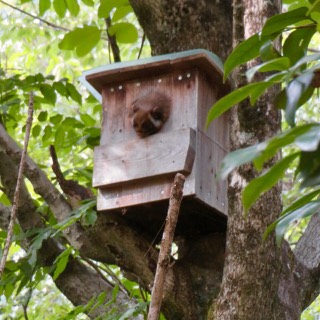 Japanese Giant Flying Squirrel (reference photo)

Species Data
- Classification
- Rodentia / Sciuridae Source
- Size
- Head-body length 27–49 cm (tail 28–41 cm)
- Weight
- 700–1,500 g
- Lifespan
- Wild: about 6–10 years / captive: about 15 years
- Diet
- Herbivore Herbivorous, eating young leaves of zelkova and maple, seeds, acorns, persimmon fruit, camellia flowers, and bark according to the season; does not forage on the ground
- Activity
- Nocturnal and fully arboreal; does not hibernate
- Distribution
- Endemic to Japan, found across Honshu, Shikoku, and Kyushu. Source
- Sources
- ja.wikipedia.org en.wikipedia.org
Did You Know?
- It can glide over 120 meters at speeds up to 16 m/s, using a cartilage spur at the wrist to expand its gliding membrane for greater distance. Source
- Its gliding membrane extends not only between the fore and hind limbs but also from the neck and to the tail, forming a full-body gliding surface. Source
- During mating, males form a 'copulatory plug' inside females, thought to prevent semen leakage and deter rival males. Source
Where to See This Species
Operating facilities registered on this site: Japan 6
Kyoto City ZooKyotoOpened in 1903
Kiryuugaoka DoubutsuenGunmaIf driving, set your car navigation to "Kiryugaoka Amusement Park" (Kiryugaoka Yuenchi) rather than "Kiryugaoka Zoo" to reach the parking lot (searching by the zoo name may give an incorrect route).
Hirakawa ZooKagoshimaAbout a 20-minute walk from Goino Station on the JR Ibusuki-Makurazaki Line, or take a bus bound for Taniyama / Dobutsuen from Fukuhira Nokyo-mae to the last stop.
Naganoshichausuyama DoubutsuenNaganoThe nearest station is JR Shinonoi Station.
Toyamashifamiri ParkToyamaOpened in 1984
Higashiyama Zoo and Botanical GardensAichiOpened in 1937
- ムササビLIVE 2026.9.10
- ムササビLIVE
- ムササビLIVE
- ムササビLIVE
- ムササビLIVE 2026.9.9
- 【夜ならば】到津の森公園で「夜間開園で見ることのできたムササビのコタローの行動」他 本日の注目情報セレクション
Source links to official sites, official YouTube channels, and news aggregators such as Zoo Ring. Visit the publisher for the full item.
Conservation Story
Conservation Status
Least Concern (LC)
Sources
Support Conservation
A visit is a small, positive way to support the daily lives of the animals you care about.
- Visit
- A visit itself helps support the facility.
- Animal Supporter Programs & Giving
- Find ways to support the facility through its official website.
- Furusato Nozei
- Municipally run facilities may share official guidance for this Japanese hometown-tax program.
FAQ
- How far can a Japanese giant flying squirrel glide?
- It can glide over 120 meters in a single leap, reaching speeds of up to 16 meters per second. Source
- Does it ever come down to the ground?
- No. It is a strict arboreal forager, feeding entirely on leaves, seeds, and fruit found in the tree canopy. Source
- How many operating facilities are registered here?
- Operating facilities registered on this site: Japan 6 Source
Books & gear
Source: ja.wikipedia.org en.wikipedia.org