Japanese Rice Fish (Medaka)メダカ
Oryzias latipesLC— Least Concern
The Japanese rice fish, or medaka (Oryzias latipes), is a small freshwater fish native to rice paddies, ponds, and marshes across Japan and more broadly East and Southeast Asia. Highly tolerant of temperature and salinity extremes, it is an important model organism in genetics research and became the first vertebrate known to mate in space, aboard Space Shuttle Columbia in 1994. The species is listed as Least Concern by the IUCN.
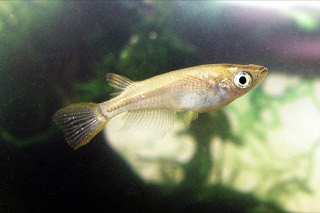 Japanese Rice Fish (Medaka) (reference photo)

Species Data
- Classification
- Beloniformes / Adrianichthyidae Source
- Size
- Body length about 3.5–3.6 cm
- Lifespan
- Wild: about a year and a few months / captive: about 3–5 years
- Diet
- Omnivore Omnivorous, eating zooplankton such as water fleas, algae and phytoplankton, and small aquatic insects (with a fondness for mosquito larvae)
- Distribution
- Native to Japan, where it is split into northern and southern lineages, and more broadly distributed across East and Southeast Asia, inhabiting rice paddies, marshes, ponds, and tide pools. Source
- Sources
- ja.wikipedia.org en.wikipedia.org
Did You Know?
- In 1994, medaka aboard Space Shuttle Columbia became the first vertebrates known to mate and lay eggs in orbit. Source
- Medaka recognize other individuals using facial visual cues and, like mammals, show the "inversion effect" when faces are turned upside down. Source
- Its well-developed kidney function gives it remarkable salt tolerance, allowing it to survive in seawater once acclimated. Source
Where to See This Species
Operating facilities registered on this site: Japan 6
Ishikawa DoubutsuenIshikawaAbout 60 minutes from the Kanazawa-Morimoto Interchange on the Hokuriku Expressway, about 40 minutes from the Kanazawa-Nishi Interchange, and about 20 minutes from the Komatsu Interchange.
Kagoshima City AquariumKagoshimaFrom Kagoshima-Chuo Station, take the tram (Route 2) to the Suizokukan-guchi stop and walk 8 minutes.
Minatoyama SuizokukanHyogoOpened in 2022
Nagasakipengin SuizokukanNagasakiOpened in 2001
Toyamashifamiri ParkToyamaOpened in 1984
Higashiyama Zoo and Botanical GardensAichiOpened in 1937
Former facilities
Keikyuuaburatsubomarin ParkKanagawaOpened in 1968
Closed: 2021-09-30 Official Site
Source links to official sites, official YouTube channels, and news aggregators such as Zoo Ring. Visit the publisher for the full item.
Conservation Story
Conservation Status
Least Concern (LC)
Sources
Support Conservation
A visit is a small, positive way to support the daily lives of the animals you care about.
- Visit
- A visit itself helps support the facility.
- Animal Supporter Programs & Giving
- Find ways to support the facility through its official website.
- Furusato Nozei
- Municipally run facilities may share official guidance for this Japanese hometown-tax program.
FAQ
- Why are medaka important to science?
- Their small genome, rapid breeding cycle, and tolerance of lab conditions make them a widely used model organism, and they were the first vertebrates known to mate in space. Source
- What do medaka eat?
- They are omnivorous, feeding on zooplankton such as water fleas, mosquito larvae, algae, and phytoplankton. Source
- Can medaka survive in salt water?
- Yes; their well-developed kidneys give them unusually high salt tolerance, letting them live in seawater once acclimated. Source
- How many operating facilities are registered here?
- Operating facilities registered on this site: Japan 6 Source
Books & gear
Source: ja.wikipedia.org en.wikipedia.org