Leopard Geckoヒョウモントカゲモドキ
Eublepharis maculariusLC— Least Concern
The leopard gecko is a nocturnal, ground-dwelling lizard native to the arid rocky grasslands of Afghanistan, Pakistan, Iran, and northwestern India. It stores fat in its tail, which can swell nearly as wide as its head when well fed, and determines the sex of its offspring by incubation temperature rather than sex chromosomes. Thanks to decades of selective breeding for color morphs, it is widely regarded as the first domesticated lizard species and remains one of the most popular reptile pets worldwide.
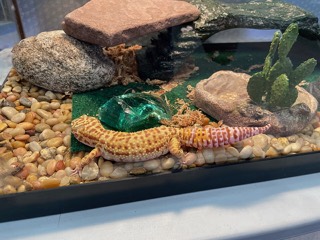 Leopard Gecko (reference photo)
,_Entomica_1.jpg)
Species Data
- Classification
- Squamata / Eublepharidae Source
- Size
- Total length: males 20–28 cm, females 18–20 cm (snout-vent length: males 11–15.8 cm, females 10.9–12.7 cm)
- Weight
- Adults: males 60–80 g, females 50–70 g
- Lifespan
- Average about 5 years in the wild. Often exceeds 20 years in captivity, with records of 29 years for a male and about 22 years for a female
- Diet
- Insectivore Carnivorous, feeding mainly on insects such as beetles, orthopterans, and moth and butterfly larvae, as well as spiders, scorpions, myriapods, and occasionally small vertebrates
- Activity
- Nocturnal, but shows crepuscular tendencies in some seasons
- Distribution
- Native to arid, rocky grasslands and deserts of Afghanistan, Pakistan, northwestern India, Iran, and western Nepal. Source
- Sources
- ja.wikipedia.org en.wikipedia.org
Did You Know?
- The tail serves as a fat-storage organ, and in well-fed individuals it can swell to nearly the same width as the head. Source
- Leopard geckos lack sex chromosomes; instead, sex is determined by the incubation temperature of the egg, a phenomenon known as temperature-dependent sex determination. Source
- As polyphyodonts, leopard geckos continuously replace each of their roughly 100 teeth every three to four months throughout life, and extensive captive breeding has led them to be regarded as the first domesticated lizard species. Source
Where to See This Species
Operating facilities registered on this site: Japan 4
Kyoto City ZooKyotoOpened in 1903
Kiryuugaoka DoubutsuenGunmaIf driving, set your car navigation to "Kiryugaoka Amusement Park" (Kiryugaoka Yuenchi) rather than "Kiryugaoka Zoo" to reach the parking lot (searching by the zoo name may give an incorrect route).
Fukuoka Zoo & Botanical GardenFukuokaOpened in 1953
Higashiyama Zoo and Botanical GardensAichiOpened in 1937
Conservation Story
Conservation Status
Least Concern (LC)
Sources
Support Conservation
A visit is a small, positive way to support the daily lives of the animals you care about.
- Visit
- A visit itself helps support the facility.
- Animal Supporter Programs & Giving
- Find ways to support the facility through its official website.
- Furusato Nozei
- Municipally run facilities may share official guidance for this Japanese hometown-tax program.
FAQ
- Why does a leopard gecko's tail look so fat sometimes?
- The tail functions as a fat-storage organ; well-fed individuals build up reserves there, and the tail can swell to nearly the width of the head. Source
- How is the sex of a leopard gecko determined?
- Leopard geckos have no sex chromosomes; the incubation temperature of the egg determines whether a hatchling develops as male or female, a trait called temperature-dependent sex determination. Source
- How long do leopard geckos live?
- In the wild they average only around 5 years, but in captivity with proper care they commonly live 20 years or more, with documented records of 29 years for a male and about 22 years for a female. Source
- How many operating facilities are registered here?
- Operating facilities registered on this site: Japan 4 Source
Books & gear
Source: ja.wikipedia.org en.wikipedia.org