Loggerhead Sea Turtleアカウミガメ
Caretta carettaVU— Vulnerable
The loggerhead sea turtle is named for its unusually large head and powerful jaws, which it uses to crush hard-shelled prey like conchs and whelks. Found across the Atlantic, Pacific, and Indian Oceans, it undertakes vast transoceanic migrations—hatchlings from Japanese beaches travel all the way to foraging grounds off Mexico. Classified as Vulnerable by the IUCN, it faces threats from bycatch, coastal development, and nesting beach loss.
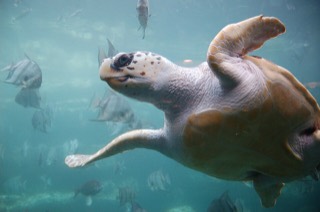 Loggerhead Sea Turtle (reference photo)

Species Data
- Classification
- Testudines / Cheloniidae Source
- Size
- Carapace length of nesting females 65.4–105.3 cm; adults are generally around 90 cm
- Weight
- About 70–180 kg (record 545 kg)
- Lifespan
- Thought to be 47–67 years in the wild, with sexual maturity taking 17–33 years; one captive individual hatched in 1950 is still alive at 76
- Diet
- Omnivore Omnivorous with a strong animal bias, eating a wide range of mollusks, crustaceans, squid, fish, and seaweed; its powerful jaws crush hard shells whole
- Activity
- Mainly diurnal; spends up to 85% of the day submerged, with each dive lasting about 15–30 minutes
- Distribution
- Distributed throughout the Atlantic, Pacific, and Indian Oceans as well as the Mediterranean Sea; in Japan, nesting beaches stretch from Kujukuri in Chiba Prefecture to Yakushima. Source
- Sources
- ja.wikipedia.org en.wikipedia.org
Did You Know?
- The English name "loggerhead" refers to its unusually large head, reflecting the powerful jaws it uses to crush hard-shelled prey. Source
- Hatchlings from Japanese nesting beaches are known to migrate across the entire Pacific Ocean to foraging grounds off Mexico's Baja California Peninsula. Source
- Females lay 70 to 150 eggs per clutch and can produce one to five clutches within a single nesting season. Source
Where to See This Species
Operating facilities registered on this site: Japan 10
How to tell Sea Turtles apart →Port of Nagoya Public AquariumAichi5 minutes on foot from Exit 3 of Nagoyako Station on the Subway Meiko Line (transfer to the Meiko Line at Sakae Station on the Higashiyama Line, or at Kanayama Station on the Meitetsu and JR lines).
Kamogawa Sea WorldChibaAbout 2 hours from Tokyo Station on the Wakashio limited express to JR Awa-Kamogawa Station, then about 10 minutes by free shuttle bus (departing from the West Exit bus stop).
Murotohaikou SuizokukanKochiOpened in 2018
Echizen Matsushima AquariumFukuiOpened in 1959
Okinawa Churaumi AquariumOkinawaOpened in 2002
Shimoda AquariumShizuokaOpened in 1967
Osaka Aquarium KaiyukanOsakaOpened in 1990
Kiryuugaoka DoubutsuenGunmaIf driving, set your car navigation to "Kiryugaoka Amusement Park" (Kiryugaoka Yuenchi) rather than "Kiryugaoka Zoo" to reach the parking lot (searching by the zoo name may give an incorrect route).
Himeji Shiritsu DoubutsuenHyogoOpened in 1951
Hiwasa Sea Turtle Museum "Caretta"TokushimaOpened in 1985
- 第438回 串本町内で久々のアカウミガメ産卵 - スタッフブログ さびうらびより|串本海中公園
- アカウミガメ回遊調査~part5 放流~ #名古屋港水族館 #ウミガメ #STRETCH #shorts
- アカウミガメ回遊調査~part 4 船の中でのお世話~ #名古屋港水族館 #shorts #ウミガメ #STRETCH
- (トピックス水槽)ウミガメの卵 - イベント&新着情報|串本海中公園
- アカウミガメ回遊調査~part3 船の中でのエサ~ #名古屋港水族館 #ウミガメ #STRETCH
- アカウミガメ誕生 #名古屋港水族館 #shorts
Source links to official sites, official YouTube channels, and news aggregators such as Zoo Ring. Visit the publisher for the full item.
Conservation Story
Conservation Status
Vulnerable (VU)
Support Conservation
A visit is a small, positive way to support the daily lives of the animals you care about.
- Visit
- A visit itself helps support the facility.
- Animal Supporter Programs & Giving
- Find ways to support the facility through its official website.
- Furusato Nozei
- Municipally run facilities may share official guidance for this Japanese hometown-tax program.
- Support Port of Nagoya Public Aquarium
- Support Kamogawa Sea World
- Support Murotohaikou Suizokukan
- Support Echizen Matsushima Aquarium
- Support Okinawa Churaumi Aquarium
- Support Shimoda Aquarium
- Support Osaka Aquarium Kaiyukan
- Support Kiryuugaoka Doubutsuen
- Support Himeji Shiritsu Doubutsuen
- Support Hiwasa Sea Turtle Museum "Caretta"
FAQ
- Why is it called the loggerhead sea turtle?
- Its English name refers to its unusually large, block-shaped head, which houses powerful jaw muscles used to crush hard-shelled prey such as conchs and whelks. Source
- How far do loggerhead sea turtles migrate?
- Hatchlings from Japanese nesting beaches make one of the longest known sea turtle migrations, crossing the entire Pacific Ocean to feeding grounds off Mexico's Baja California Peninsula before eventually returning to breed. Source
- How long do loggerhead sea turtles live?
- In the wild they are estimated to live 47 to 67 years and take 17 to 33 years to reach sexual maturity; a captive individual hatched in 1950 was still alive at around 76 years old. Source
- How many operating facilities are registered here?
- Operating facilities registered on this site: Japan 10 Source
Books & gear
Source: ja.wikipedia.org en.wikipedia.org