Malayan Tapirマレーバク
Tapirus indicusEN— Endangered
The Malayan tapir is the largest tapir species and the only one native to Asia, found in the rainforests of the Malay Peninsula, Sumatra, Myanmar, and southern Thailand. Its bold black-and-white coloring helps break up its silhouette to predators at night, while calves are born with a completely different striped-and-spotted coat. With fewer than 2,500 mature individuals left due to deforestation, the IUCN classifies it as Endangered.
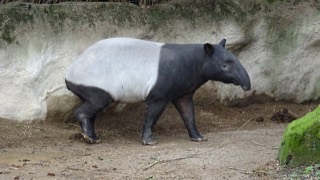 Malayan Tapir (reference photo)

Species Data
- Classification
- Perissodactyla / Tapiridae Source
- Size
- Body length 180–250 cm
- Weight
- 250–540 kg
- Lifespan
- Up to about 30 years in both the wild and captivity
- Diet
- Herbivore Herbivorous, feeding mainly on the young leaves and fruit of more than 115 plant species
- Activity
- Crepuscular to nocturnal
- Distribution
- Native to the Malay Peninsula, Sumatra, southern Thailand, and Myanmar; it is the largest tapir species and the only one found outside the Americas. Source
- Sources
- ja.wikipedia.org en.wikipedia.org
Did You Know?
- Its black-and-white coloration is thought to break up its outline at night, making the animal harder for predators to spot. Source
- Calves under six months old display a distinctive coat of white stripes and spots that differs entirely from the adult pattern. Source
- Listed as Endangered by the IUCN, with fewer than 2,500 mature individuals remaining; oil palm plantation expansion and deforestation are the primary threats. Source
Where to See This Species
Operating facilities registered on this site: Japan 7
Adventure WorldWakayamaOpened in 1978
Yokohama Shiritsu Yokohama DoubutsuenKanagawaOpened in 1999
Hiroshima City Asa Zoological ParkHiroshimaFrom JR Hiroshima Station, take the Sanyo Main Line or Kabe Line to Shin-Hakushima Station, transfer to the Astram Line to Kamiyasu Station, then take a bus to "Asa Dobutsu Koen" (about 45 minutes in total).
Chiba Zoological ParkChibaOpened in 1985
TOBU ZOOSaitamaFrom Tobu-Dobutsu-Koen Station (west exit), about 10 minutes on foot (600 m) or about 5 minutes by bus.
Fukuoka Zoo & Botanical GardenFukuokaOpened in 1953
Higashiyama Zoo and Botanical GardensAichiOpened in 1937
- 日没後のマレーバクたち#東武動物公園#zoo#動物#animals#マレーバク#tapir
- 7月10日(金)からマレーバク「カナエ」「カナタ」の展示を開始します!
- 6月22日(月)マレーバクが誕生しました!
Source links to official sites, official YouTube channels, and news aggregators such as Zoo Ring. Visit the publisher for the full item.
Conservation Story
Conservation Status
Endangered (EN)
Sources
Support Conservation
A visit is a small, positive way to support the daily lives of the animals you care about.
- Visit
- A visit itself helps support the facility.
- Animal Supporter Programs & Giving
- Find ways to support the facility through its official website.
- Furusato Nozei
- Municipally run facilities may share official guidance for this Japanese hometown-tax program.
FAQ
- Why does the Malayan tapir have black-and-white coloring?
- The stark two-tone pattern is thought to break up the animal's outline in dim forest light, making it harder for predators such as tigers to identify it as prey. Source
- Is the Malayan tapir endangered?
- Yes. The IUCN lists it as Endangered, with fewer than 2,500 mature individuals remaining, mainly due to habitat loss from logging and oil palm plantations. Source
- Are baby tapirs the same color as adults?
- No. Calves are born with a coat of white stripes and spots for camouflage, which they lose within about six months as the adult black-and-white pattern develops. Source
- How many operating facilities are registered here?
- Operating facilities registered on this site: Japan 7 Source
Books & gear
Source: ja.wikipedia.org en.wikipedia.org