Mudskipperムツゴロウ
Boleophthalmus pectinirostrisLC— Least Concern
The great blue-spotted mudskipper (Boleophthalmus pectinirostris), known in Japan as mutsugoro, is an amphibious goby that lives on muddy tidal flats in Japan's Ariake and Yatsushiro seas, as well as coastal Korea, China, and Taiwan. It breathes partly through its skin and water held in its mouth, allowing it to leave the water and crawl on its pectoral fins or leap across mud while grazing on diatoms and other benthic algae. It is listed as Least Concern by the IUCN.
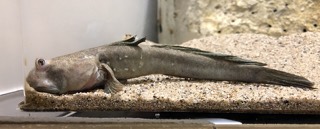 Mudskipper (reference photo)

Species Data
- Classification
- Gobiiformes / Oxudercidae Source
- Size
- Total length about 15 cm, reaching a maximum of about 20 cm
- Diet
- Herbivore Herbivorous, feeding on benthic algae such as diatoms on the surface of tidal-flat mud
- Distribution
- Native to the northwestern Pacific including Japan, eastern China, Taiwan, and the Korean Peninsula, inhabiting muddy tidal flats near river mouths and mangroves; in Japan it is restricted to the Ariake and Yatsushiro seas. Source
- Sources
- ja.wikipedia.org en.wikipedia.org
Did You Know?
- It can breathe through its skin and water held in its mouth, letting it leave the water to crawl on its pectoral fins or leap using its whole body. Source
- When fleeing, it makes rapid, frog-like consecutive jumps, making it surprisingly hard to catch. Source
- In the Ariake Sea region, it is traditionally caught using a technique called "mutsukake," which resembles fly fishing with a hook. Source
Where to See This Species
Operating facilities registered on this site: Japan 1
Nagasakipengin SuizokukanNagasakiOpened in 2001
Source links to official sites, official YouTube channels, and news aggregators such as Zoo Ring. Visit the publisher for the full item.
Conservation Story
Conservation Status
Least Concern (LC)
Sources
Support Conservation
A visit is a small, positive way to support the daily lives of the animals you care about.
- Visit
- A visit itself helps support the facility.
- Animal Supporter Programs & Giving
- Find ways to support the facility through its official website.
- Furusato Nozei
- Municipally run facilities may share official guidance for this Japanese hometown-tax program.
FAQ
- How does a mudskipper breathe out of water?
- It breathes partly through its skin and through water it holds in its mouth, letting it stay active on exposed mudflats. Source
- What does the mudskipper eat?
- It is herbivorous, grazing on diatoms and other benthic algae from the surface of the mud. Source
- Why is it hard to catch a mudskipper?
- When fleeing, it makes rapid, frog-like consecutive jumps across the mud, which makes it surprisingly difficult to catch. Source
- How many operating facilities are registered here?
- Operating facilities registered on this site: Japan 1 Source
Books & gear
Source: ja.wikipedia.org en.wikipedia.org