Red Stingrayアカエイ
Hemitrygon akajeiEN— Endangered
The red stingray (Hemitrygon akajei) is a whiptail stingray found along the coasts of Japan, Korea, China, and Taiwan, with a diamond-shaped disc up to about 0.66 m across, an orange-red underside, and a total length of up to 2 m. It feeds mainly on crustaceans along with small fish and worms, and its tail bears one or two venomous spines capable of causing severe, long-lasting pain. Valued as a food fish in parts of Japan, it is classified Near Threatened by the IUCN amid a long-term decline in Japanese landings.
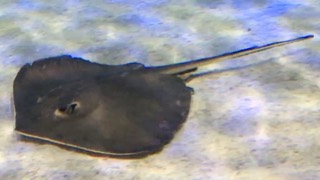 Red Stingray (reference photo)

Species Data
- Classification
- Myliobatiformes / Dasyatidae Source
- Size
- Records of a maximum total length of about 2 m, disc width of about 0.66 m, and weight of about 10.7 kg (most individuals have a disc width under 1 m)
- Diet
- Carnivore Carnivorous, feeding mainly on crustaceans and on a wide range of benthic animals including small bony fish, polychaetes, mollusks, and cephalopods
- Distribution
- Found throughout Japanese coastal waters from Hokkaido to Okinawa, as well as off Korea, mainland China, and Taiwan, with unconfirmed reports from Thailand, the Philippines, Fiji, and Tuvalu. Source
- Sources
- ja.wikipedia.org en.wikipedia.org
Did You Know?
- The tail bears one or two venomous spines several to ten centimeters long, capable of causing intense pain that can last for weeks; barbs on the spine make it difficult to remove once lodged. Source
- Steve Irwin, known as the "Crocodile Hunter," died after being pierced by the venomous spine of a stingray in the same family. Source
- The Ainu people historically removed the venomous tail spine and used it as a weapon, fitted to spears or arrows. Source
Where to See This Species
Operating facilities registered on this site: Japan 4
NOTOJIMA AQUARIUMIshikawaThe nearest station is Wakura-Onsen Station.
Echizen Matsushima AquariumFukuiOpened in 1959
Kyoto AquariumKyotoAbout a 15-minute walk from the central exit of JR Kyoto Station.
Nagasakipengin SuizokukanNagasakiOpened in 2001
Source links to official sites, official YouTube channels, and news aggregators such as Zoo Ring. Visit the publisher for the full item.
Conservation Story
Conservation Status
Endangered (EN)
Sources
Support Conservation
A visit is a small, positive way to support the daily lives of the animals you care about.
- Visit
- A visit itself helps support the facility.
- Animal Supporter Programs & Giving
- Find ways to support the facility through its official website.
- Furusato Nozei
- Municipally run facilities may share official guidance for this Japanese hometown-tax program.
FAQ
- Is the red stingray dangerous?
- Yes; its tail carries one or two venomous, barbed spines that can cause severe pain lasting weeks if a person is stung. Source
- What does the red stingray eat?
- It feeds mainly on crustaceans, along with small bony fish and marine worms. Source
- Is the red stingray eaten as food?
- Yes, it is valued as food in parts of Japan, particularly around Tokyo Bay, where it is eaten in autumn and winter. Source
- How many operating facilities are registered here?
- Operating facilities registered on this site: Japan 4 Source
Books & gear
Source: ja.wikipedia.org en.wikipedia.org