Green Sea Turtleアオウミガメ

Chelonia mydasEN— Endangered

The green sea turtle is one of the largest sea turtles, found throughout tropical and subtropical waters of the Indian, Atlantic, and Pacific Oceans, with major Japanese nesting sites in the Ogasawara and Ryukyu Islands. Juveniles eat some animal matter, but adults become almost entirely herbivorous, grazing on seagrass and algae—an unusual trait among marine reptiles. Decades of overharvesting, bycatch, and nesting habitat loss have led the IUCN to classify it as Endangered.

Operating facilities registered on this site: Japan 9 · Overseas 1 (Sumida Aquarium, Port of Nagoya Public Aquarium, Kamogawa Sea World, and 6 more). These facilities are confirmed by resident animal records or the facility’s official information.
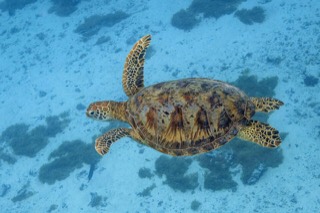
Green Sea Turtle (reference photo)
Photo: Charles J. Sharp / CC BY-SA 4.0 / Source / cropped

Species Data

Classification
Testudines / Cheloniidae Source
Size
Carapace length varies by population; at 99–111.8 cm in the Atlantic population, it is among the largest of the sea turtles
Weight
Adults 68–190 kg; a large individual reached a record 395 kg
Lifespan
Takes 20–50 years to reach sexual maturity, after which it may live about 90 years in the wild
Diet
Herbivore Juveniles also eat animal matter, but adults feed mainly on seagrasses such as eelgrass and Halophila, making it one of the few herbivorous marine reptiles
Distribution
Widely distributed across tropical and subtropical waters of the Indian, Atlantic, and Pacific Oceans, with nesting recorded in more than 80 countries. Source

Did You Know?

  • Its name comes not from its shell color but from the greenish tint of its body fat, colored by pigments from the seagrass and algae it eats. Source
  • It can swim at speeds up to 40 mph (64 km/h) and uses Earth's magnetic field to navigate back to its natal nesting beach. Source

Where to See This Species

Operating facilities registered on this site: Japan 9 · Overseas 1

How to tell Sea Turtles apart →

Sumida AquariumTokyoRight by Tokyo Skytree Station on the Tobu Skytree Line.

Source

No.0378In residence

Hoshi

星

Green Sea TurtleChelonia mydas

Sex
Unknown
Born
July 13, 2026
EN— Endangered
No.1183In residence

Sora

空

Green Sea TurtleChelonia mydas

Sex
Unknown
Born
July 13, 2026
EN— Endangered

Port of Nagoya Public AquariumAichi5 minutes on foot from Exit 3 of Nagoyako Station on the Subway Meiko Line (transfer to the Meiko Line at Sakae Station on the Higashiyama Line, or at Kanayama Station on the Meitetsu and JR lines).

Source

Kamogawa Sea WorldChibaAbout 2 hours from Tokyo Station on the Wakashio limited express to JR Awa-Kamogawa Station, then about 10 minutes by free shuttle bus (departing from the West Exit bus stop).

Source

Osaka Aquarium KaiyukanOsakaOpened in 1990

Source

Kagoshima City AquariumKagoshimaFrom Kagoshima-Chuo Station, take the tram (Route 2) to the Suizokukan-guchi stop and walk 8 minutes.

Source

Umi KiraraNagasaki1008 Kashimae-cho, Sasebo, Nagasaki Prefecture.

Source

Minami Chita Beach LandAichiOpened in 1980

Source

Oga Aquarium GaoAkitaOpened in 2004

Source

New England AquariumOpened in 1969

No.0799In residence

Myrtle

Myrtle

Green Sea TurtleChelonia mydas

Sex
Female
Born
Unknown
EN— Endangered
Possible records, not yet confirmed: 12

These facilities are not confirmed by an official animal list. They appear in secondary sources such as Wikipedia; check the facility’s official website for current exhibits.

Aquarium in Susami, WakayamaWakayama

(Not confirmed by official sources) Source

NOTOJIMA AQUARIUMIshikawaThe nearest station is Wakura-Onsen Station.

(Not confirmed by official sources) Source

Muroto Schoolhouse AquariumKochiOpened in 2018

(Not confirmed by official sources) Source

Echizen Matsushima AquariumFukuiOpened in 1959

(Not confirmed by official sources) Source

Okinawa Churaumi AquariumOkinawaOpened in 2002

(Not confirmed by official sources) Source

Shimoda AquariumShizuokaOpened in 1967

(Not confirmed by official sources) Source

Kyoto AquariumKyotoAbout a 15-minute walk from the central exit of JR Kyoto Station.

(Not confirmed by official sources) Source

Zoo in Kiryū, GunmaGunmaOpened in 1953

(Not confirmed by official sources) Source

Otaru AquariumHokkaidoOpened in 1958

(Not confirmed by official sources) Source

AQUARIUM ASAMUSHIAomoriOpened in 1983

(Not confirmed by official sources) Source

SENDAI UMINO-MORI AQUARIUMMiyagiOpened in 2015

(Not confirmed by official sources) Source

Toba AquariumMieOpened in 1955

(Not confirmed by official sources) Source

Latest news

4

Open the news index

Source links to official sites, official YouTube channels, and news aggregators such as Zoo Ring. Visit the publisher for the full item.

Conservation Story

Conservation Status

Endangered (EN)

Sources

ja.wikipedia.org www.iucnredlist.org

Support Conservation

A visit is a small, positive way to support the daily lives of the animals you care about.

Visit
A visit itself helps support the facility.
Animal Supporter Programs & Giving
Find ways to support the facility through its official website.
Furusato Nozei
Municipally run facilities may share official guidance for this Japanese hometown-tax program.

FAQ

Where can I see Green Sea Turtle in Japan?
Operating facilities registered on this site: Japan 9 · Overseas 1 (Sumida Aquarium, Port of Nagoya Public Aquarium, Kamogawa Sea World, and 6 more). These facilities are confirmed by resident animal records or the facility’s official information. Source
Why is it called the 'green' sea turtle?
The name refers to the greenish color of its body fat, tinted by pigments from the seagrass and algae that make up most of its adult diet, not the color of its shell. Source
Where do green sea turtles nest in Japan?
The Ogasawara Islands are the primary nesting site, with additional nesting recorded in the Ryukyu Islands of southwestern Japan. Source

Books & gear

Source: ja.wikipedia.org en.wikipedia.org