Reindeerトナカイ

Rangifer tarandusVU— Vulnerable

The reindeer, known as caribou in North America, is a circumpolar deer of Arctic and subarctic tundra, boreal forest, and mountain habitats across Northern Europe, Siberia, and North America. It is the only deer species in which females commonly grow antlers, using them alongside males to dig through snow for lichen. Once abundant, many wild herds have declined sharply—such as Quebec's George River herd, which fell from roughly 800,000–900,000 animals in the 1990s to fewer than 9,000 by 2018—and the IUCN now classifies the species as Vulnerable.

Operating facilities registered on this site: Japan 3 (Asahiyama Zoo, Kushiro Zoo, Nasu Animal Kingdom). These facilities are confirmed by resident animal records or the facility’s official information.
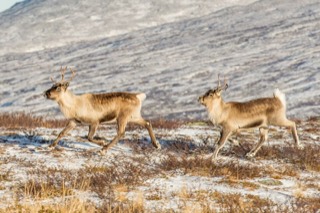
Reindeer (reference photo)
Photo: Arild Vågen / CC BY-SA 4.0 / Source / cropped

Species Data

Classification
Artiodactyla / Cervidae Source
Size
Body length 120–230 cm, shoulder height 90–150 cm
Weight
60–300 kg (varies greatly by subspecies)
Lifespan
Captive: average about 10 years for males and about 15 years for females
Diet
Herbivore Strongly herbivorous omnivore; in summer eats grasses and leaves as well as small animals such as lemmings and insects, and in winter digs through snow with its antlers and hooves to reach lichens beneath
Distribution
Reindeer have a circumpolar distribution across Arctic, subarctic, tundra, boreal, and mountainous regions of Northern Europe, Siberia, and North America, including Alaska, Canada, and Greenland. Source

Did You Know?

  • Reindeer are unique among deer species in that females, as well as males, commonly grow antlers—an adaptation used for digging through snow to reach lichen. Source
  • Their eye color shifts with the seasons, changing from golden in summer to deep blue in winter, an adaptation linked to enhanced UV-light detection in the dark Arctic winter. Source
  • The reindeer is the only deer species that has been successfully semi-domesticated on a large scale, long supporting the livelihoods of Arctic Indigenous peoples such as the Sámi. Source

Where to See This Species

Operating facilities registered on this site: Japan 3

Asahiyama ZooHokkaidoOpened in 1967

Source

Kushiro ZooHokkaidoOpened in 1975

Source

Nasu Animal KingdomTochigiAbout 50 minutes by car from Nasu-Shiobara Station on the Tohoku Shinkansen (a free shuttle bus is available; online reservation required by 17:00 the day before).

Source

Possible records, not yet confirmed: 4

These facilities are not confirmed by an official animal list. They appear in secondary sources such as Wikipedia; check the facility’s official website for current exhibits.

Hiroshima City Asa Zoological ParkHiroshimaFrom JR Hiroshima Station, take the Sanyo Main Line or Kabe Line to Shin-Hakushima Station, transfer to the Astram Line to Kamiyasu Station, then take a bus to "Asa Dobutsu Koen" (about 45 minutes in total).

(Not confirmed by official sources) Source

Akita City Ōmoriyama ZooAkitaFrom bus stop 7 at the west exit of the JR Akita Station bus terminal, take the Akita Chuo Kotsu "Araya Line" bus for about 30 minutes.

(Not confirmed by official sources) Source

Suzaka ZooNaganoFrom the Suzaka-Nagano-Higashi IC on the Joshin-etsu Expressway, take Route 403, turn right at the Kotaka-machi intersection, turn left at the Kami-Hatcho intersection, cross Garyu Bridge, and turn left for the south entrance.

(Not confirmed by official sources) Source

Fuji Safari ParkShizuokaOpened in 1980

(Not confirmed by official sources) Source

Former facilities

North Safari SapporoHokkaidoOpened in 2005

(Not confirmed by official sources) Source

Closed: 2025-09-30 Official Site

Conservation Story

Conservation Status

Vulnerable (VU)

Sources

ja.wikipedia.org en.wikipedia.org

Support Conservation

A visit is a small, positive way to support the daily lives of the animals you care about.

Visit
A visit itself helps support the facility.
Animal Supporter Programs & Giving
Find ways to support the facility through its official website.
Furusato Nozei
Municipally run facilities may share official guidance for this Japanese hometown-tax program.

Individuals Remembered

No.1064In memoriam

Rudorufu

ルドルフ

ReindeerRangifer tarandus

Akita City Ōmoriyama Zoo

Sex
Male
Born
May 21, 2013
VU— Vulnerable

FAQ

Where can I see Reindeer in Japan?
Operating facilities registered on this site: Japan 3 (Asahiyama Zoo, Kushiro Zoo, Nasu Animal Kingdom). These facilities are confirmed by resident animal records or the facility’s official information. Source
Do female reindeer have antlers?
Yes. Reindeer are unique among deer species in that females commonly grow antlers too, which they use along with males to dig through snow for lichen. Source
Are reindeer endangered?
The IUCN lists reindeer as Vulnerable. While some Siberian tundra herds have stabilized or grown since 2000, other populations have collapsed dramatically—Quebec's George River herd fell from about 800,000–900,000 in the 1990s to under 9,000 by 2018. Source
Why do reindeer eyes change color in winter?
Their eyes shift from golden in summer to deep blue in winter, a change thought to improve their ability to detect ultraviolet light during the long, dark Arctic winter. Source

Books & gear

Source: ja.wikipedia.org en.wikipedia.org