Spotted Garden Eelチンアナゴ
Heteroconger hassiNE— Not Evaluated
The spotted garden eel is a small, shy reef fish that lives in colonies on sandy seabeds, each individual anchored tail-first in its own burrow with only its head and upper body swaying above the sand to catch passing plankton.
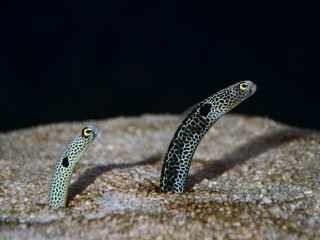 Spotted Garden Eel (reference photo)

Species Data
- Classification
- Anguilliformes / Congridae Source
- Size
- Total length about 35 cm
- Diet
- Planktivore Feeds on zooplankton carried in by the current
- Distribution
- Found throughout the tropical Indo-Pacific and Japan's Ogasawara and Ryukyu islands, living in colonies on sandy bottoms at the outer edge of coral reefs at depths of 15-45 m and water temperatures of about 25-29°C. Source
- Sources
- ja.wikipedia.org
Did You Know?
- November 11 is celebrated in Japan as "Spotted Garden Eel Day," a date chosen because the eels' upright bodies resemble the numeral 1; the designation was registered in 2013 at the request of Sumida Aquarium. Source
- Its Japanese name, chin-anago, comes from a resemblance between its face and that of the Japanese Chin dog breed. Source
Where to See This Species
Operating facilities registered on this site: Japan 7
Sumida AquariumTokyoRight by Tokyo Skytree Station on the Tobu Skytree Line.
Kyoto AquariumKyotoAbout a 15-minute walk from the central exit of JR Kyoto Station.
Kagoshima City AquariumKagoshimaFrom Kagoshima-Chuo Station, take the tram (Route 2) to the Suizokukan-guchi stop and walk 8 minutes.
Aquamarine FukushimaFukushimaOpened in 2000
Miyajima Public AquariumHiroshimaOpened in 2011
SENDAI UMINO-MORI AQUARIUMMiyagiOpened in 2015
Toba AquariumMieOpened in 1955
- Hello!チンアナゴの赤ちゃん
- 開業1,111日記念!「1111大感謝!夏のヘコアユ&チンアナゴまつり」開催 食事を観察!特別な「ヘコアユ&チンアナゴタイム」をスタート
- 京都水族館のチンアナゴたちごはんの時間 #京都水族館 #チンアナゴ #ミテッテ #ごはんの時間 #水族館 #ギャップ萌え #おもしろ動画 #京都観光 #aquarium #kyoto
- AQUARIUM × ART átoa #チンアナゴ #アート #atoa #アトア #水族館 #神戸 #kobe #수족관 ##고베 #神戶 #神户 #aquarium #shorts
- 【水族館×女子会】ヘコアユ&チンアナゴとかんぱい!「7:00pmのほろ酔い女子会」を開催します
- 【びっくり!】チンアナゴのお引越し
Source links to official sites, official YouTube channels, and news aggregators such as Zoo Ring. Visit the publisher for the full item.
Conservation Story
Conservation Status
Not Evaluated (NE)
Sources
Support Conservation
A visit is a small, positive way to support the daily lives of the animals you care about.
- Visit
- A visit itself helps support the facility.
- Animal Supporter Programs & Giving
- Find ways to support the facility through its official website.
- Furusato Nozei
- Municipally run facilities may share official guidance for this Japanese hometown-tax program.
FAQ
- Why do spotted garden eels only show their heads?
- Each eel lives permanently tail-down in a burrow it digs in the sand, keeping the lower half of its body hidden and only extending its head and upper body to feed and watch for danger. Source
- What do spotted garden eels eat?
- They feed on zooplankton carried past their burrows by ocean currents. Source
- Where are spotted garden eels found?
- They live across the tropical Indo-Pacific, including Japan's Ogasawara and Ryukyu islands, on sandy bottoms at the edge of coral reefs at depths of about 15-45 m. Source
- How many operating facilities are registered here?
- Operating facilities registered on this site: Japan 7 Source
Books & gear
Source: www.sumida-aquarium.com www.sumida-aquarium.com www.kyoto-aquarium.com