Spotted Jellyタコクラゲ
Mastigias papuaNE— Not Evaluated
The spotted jelly is a Rhizostomeae jellyfish found throughout the Indo-Pacific, from Japan and Fiji to the western Indian Ocean and Australia. It hosts photosynthetic zooxanthellae in its tissue and performs a daily vertical migration to keep its algae in sunlight, while also catching zooplankton with its cnidocyte-covered arms. It is best known from the isolated population in Palau's Jellyfish Lake, whose sting has become harmless to humans; the species' conservation status has not been formally evaluated by the IUCN.
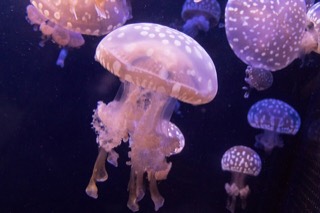 Spotted Jelly (reference photo)

Species Data
- Classification
- Rhizostomeae / Mastigiidae Source
- Size
- Bell diameter usually about 10 cm, reaching 20–30 cm in large individuals
- Diet
- Omnivore Relies mainly on photosynthetic products from symbiotic zooxanthellae in its tentacles, while also capturing small crustaceans and plankton with its tentacles
- Distribution
- Ranges throughout the Indo-Pacific from the Fijian archipelago to the western Indian Ocean and from Japan to Australia. Source
- Sources
- ja.wikipedia.org en.wikipedia.org
Did You Know?
Where to See This Species
Operating facilities registered on this site: Japan 2
Kagoshima City AquariumKagoshimaFrom Kagoshima-Chuo Station, take the tram (Route 2) to the Suizokukan-guchi stop and walk 8 minutes.
Sumida AquariumTokyoRight by Tokyo Skytree Station on the Tobu Skytree Line.
Source links to official sites, official YouTube channels, and news aggregators such as Zoo Ring. Visit the publisher for the full item.
Conservation Story
Conservation Status
Not Evaluated (NE)
Sources
Support Conservation
A visit is a small, positive way to support the daily lives of the animals you care about.
- Visit
- A visit itself helps support the facility.
- Animal Supporter Programs & Giving
- Find ways to support the facility through its official website.
- Furusato Nozei
- Municipally run facilities may share official guidance for this Japanese hometown-tax program.
FAQ
- Why does the spotted jelly migrate up and down every day?
- It rises to the surface during the day so the photosynthetic zooxanthellae living in its tissue can access sunlight, then moves deeper at night. Source
- Is it safe to touch?
- The population in Palau's Jellyfish Lake has lost most of its sting and is harmless, though jellies elsewhere still carry functional stinging cells. Source
- How many operating facilities are registered here?
- Operating facilities registered on this site: Japan 2 Source
Books & gear
Source: ja.wikipedia.org en.wikipedia.org