Sun Bearマレーグマ
Helarctos malayanusVU— Vulnerable
The sun bear is the smallest and most arboreal member of the bear family, native to the tropical forests of Southeast Asia and northeastern India. It spends much of its time in trees, using a distinctively long tongue to extract insects and honey, and is marked by a pale crescent patch on its chest. The IUCN lists it as Vulnerable, with populations having declined roughly 35 percent since the 1990s due to deforestation and poaching.
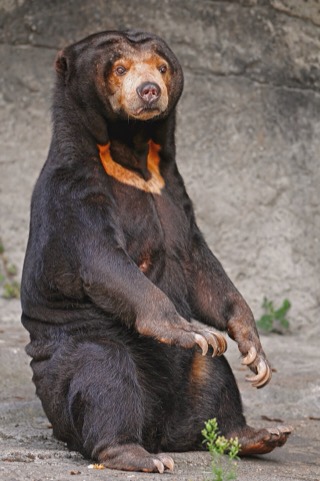 Sun Bear (reference photo)

Species Data
- Classification
- Carnivora / Ursidae Source
- Size
- Body length about 100–140 cm
- Weight
- About 25–65 kg (the smallest bear species)
- Lifespan
- Captive: records of up to about 32–34 years
- Diet
- Omnivore Omnivorous, eating lizards, birds and their eggs, small mammals, insects (termites, bee nests and honey), and fruit
- Activity
- Nocturnal; rarely descends from low branches during the day, and tends to be more nocturnal near human settlements
- Distribution
- The sun bear ranges from northeast India through Bangladesh, southwestern China, mainland Southeast Asia, Brunei, and Indonesia, though it is now locally extinct in Singapore and much of its former range. Source
- Sources
- ja.wikipedia.org en.wikipedia.org
Did You Know?
- As the smallest and most arboreal bear species, it often sleeps and sunbathes on tree branches 2 to 7 meters above the ground. Source
- It has an unusually long tongue, roughly 25 cm, which it uses to extract insects from crevices in wood. Source
- The crescent-shaped patch on its chest, said to resemble the sun, is the source of its English name. Source
Where to See This Species
Operating facilities registered on this site: Japan 8
Noichi Zoological Park of Kochi PrefectureKochiA 20-minute walk or 13-minute rental-bicycle ride from Noichi Station on the Tosa Kuroshio Railway Gomen-Nahari Line.
Sapporoshimaruyama DoubutsuenHokkaidoOpened in 1951
Hirakawa ZooKagoshimaAbout a 20-minute walk from Goino Station on the JR Ibusuki-Makurazaki Line, or take a bus bound for Taniyama / Dobutsuen from Fukuhira Nokyo-mae to the last stop.
Shuunanshitokuyama DoubutsuenYamaguchiOpened in 1960
Tennoji ZooOsakaOpened in 1915
Fukuoka Zoo & Botanical GardenFukuokaOpened in 1953
Higashiyama Zoo and Botanical GardensAichiOpened in 1937
- 【東山動植物園公式】マー子~長寿表彰おめでとう~《 マレーグマ クマ 》
- マレーグマ の寝室にあるハンモックの壁側の高さを少し上げてみました。
- 【東山動植物園公式】ある日のマー子~長寿表彰おめでとう~《 マレーグマ クマ 》
- 木の上で #マレーグマ が器用に寝ています。
- 【園長ブログ】感謝、感謝のマレーグマイベント
- スイカを食べるマレーグマのマーサ
Source links to official sites, official YouTube channels, and news aggregators such as Zoo Ring. Visit the publisher for the full item.
Conservation Story
Conservation Status
Vulnerable (VU)
Sources
Support Conservation
A visit is a small, positive way to support the daily lives of the animals you care about.
- Visit
- A visit itself helps support the facility.
- Animal Supporter Programs & Giving
- Find ways to support the facility through its official website.
- Furusato Nozei
- Municipally run facilities may share official guidance for this Japanese hometown-tax program.
FAQ
- Why is it called the sun bear?
- It is named for the pale, crescent-shaped patch of fur on its chest, which is said to resemble the sun. Source
- How big is a sun bear?
- It is the smallest bear species, with a body length of about 100 to 140 cm and a weight of roughly 25 to 65 kg. Source
- Are sun bears endangered?
- The IUCN lists sun bears as Vulnerable; their numbers have declined by about 35 percent since the 1990s due to habitat loss and poaching. Source
- How many operating facilities are registered here?
- Operating facilities registered on this site: Japan 8 Source
Books & gear
Source: ja.wikipedia.org en.wikipedia.org