Western Lowland Gorillaニシローランドゴリラ

Gorilla gorillaCR— Critically Endangered

The western lowland gorilla is the smallest and most widespread gorilla subspecies, inhabiting lowland tropical forests across Central Africa from Cameroon to the Republic of Congo. It lives in family groups led by a mature male known as a silverback, feeding mainly on fruit, leaves, and bark. Despite a global population estimated around 125,000, the IUCN lists it as Critically Endangered because of disease outbreaks, poaching, and habitat loss.
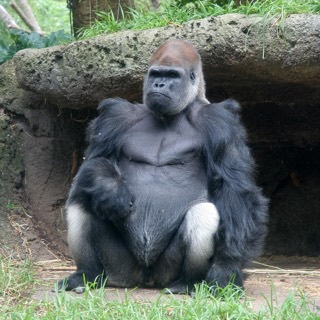
Western Lowland Gorilla (reference photo)
Photo: Macinate / CC BY 2.0 / Source / cropped

Species Data

Classification
Primates / Hominidae Source
Size
Males about 1.67 m standing / females about 1.5 m
Weight
Males average about 140 kg / females about 90 kg
Lifespan
Wild: usually 35–40 years / captive: records of over 50 years
Diet
Herbivore Herbivorous, feeding mainly on roots, shoots, fruit, wild celery, bark, and fruit pulp; the balance of fruit and leaves shifts with the season
Activity
Diurnal; travels 3–5 km a day while foraging
Distribution
The western lowland gorilla inhabits montane and lowland tropical forests across Central Africa, including Cameroon, the Central African Republic, the Republic of Congo, the Democratic Republic of Congo, Equatorial Guinea, Gabon, and Cabinda (Angola). Source

Did You Know?

  • Wild individuals have been observed using tools, such as branches for measuring water depth or extracting ants. Source
  • Mature males develop a patch of silvery-grey hair across the back and rump, earning the nickname "silverback," and typically lead the group. Source
  • An Ebola outbreak in 2003–2004 devastated some populations, killing roughly two-thirds of gorillas in affected areas. Source

Where to See This Species

Operating facilities registered on this site: Japan 7

Higashiyama Zoo and Botanical GardensAichiOpened in 1937

Source

No.0148In residence

Shabani

シャバーニ

Western Lowland GorillaGorilla gorilla

Sex
Male
Born
October 20, 1996
CR— Critically Endangered
No.0149In residence

Kiyomasa

キヨマサ

Western Lowland GorillaGorilla gorilla

Sex
Male
Born
November 1, 2012
CR— Critically Endangered

Kyoto City ZooKyotoOpened in 1903

Source

No.0150In residence

Momotaro

モモタロウ

Western Lowland GorillaGorilla gorilla

Sex
Male
Born
July 3, 2000
CR— Critically Endangered
No.0151In residence

Genki

ゲンキ

Western Lowland GorillaGorilla gorilla

Sex
Female
Born
June 24, 1986
CR— Critically Endangered
No.0152In residence

Kintaro

キンタロウ

Western Lowland GorillaGorilla gorilla

Sex
Male
Born
December 19, 2018
CR— Critically Endangered
No.0153In residence

Santaro

サンタロウ

Western Lowland GorillaGorilla gorilla

Sex
Male
Born
November 24, 2025
CR— Critically Endangered

Chiba Zoological ParkChibaOpened in 1985

Source

No.0154In residence

Momoka

モモカ

Western Lowland GorillaGorilla gorilla

Sex
Female
Born
April 24, 2013
CR— Critically Endangered

Ueno ZooTokyoOpened in 1882

Source

No.0155In residence

Gentaro

ゲンタロウ

Western Lowland GorillaGorilla gorilla

Sex
Male
Born
December 21, 2011
CR— Critically Endangered
No.0156In residence

Ani

アニー

Western Lowland GorillaGorilla gorilla

Sex
Female
Born
June 2, 2013
CR— Critically Endangered
No.0157In residence

Haoko

ハオコ

Western Lowland GorillaGorilla gorilla

Sex
Male
Born
August 21, 1993
CR— Critically Endangered
No.0158In residence

Komomo

コモモ

Western Lowland GorillaGorilla gorilla

Sex
Female
Born
November 14, 2009
CR— Critically Endangered
No.0159In residence

Riki

リキ

Western Lowland GorillaGorilla gorilla

Sex
Male
Born
October 9, 2017
CR— Critically Endangered
No.0160In residence

Sumomo

スモモ

Western Lowland GorillaGorilla gorilla

Sex
Female
Born
May 31, 2022
CR— Critically Endangered

Asahiyama ZooHokkaidoOpened in 1967

Source

Sapporoshimaruyama DoubutsuenHokkaidoOpened in 1951

Source

Hamamatsu Zoological GardensShizuokaOpened in 1950

Source

Latest news

3

Open the news index

Source links to official sites, official YouTube channels, and news aggregators such as Zoo Ring. Visit the publisher for the full item.

Conservation Story

Conservation Status

Critically Endangered (CR)

Sources

ja.wikipedia.org

Support Conservation

A visit is a small, positive way to support the daily lives of the animals you care about.

Visit
A visit itself helps support the facility.
Animal Supporter Programs & Giving
Find ways to support the facility through its official website.
Furusato Nozei
Municipally run facilities may share official guidance for this Japanese hometown-tax program.

FAQ

Why is the western lowland gorilla critically endangered despite having a large population?
Even with an estimated 125,000 individuals remaining, the population has suffered severe losses from Ebola outbreaks, commercial bushmeat hunting, and habitat destruction, all of which continue to threaten its long-term survival. Source
What is a silverback?
A silverback is a mature male gorilla that has developed a patch of silvery-grey hair on its back, a sign of maturity, and typically serves as the leader of its family group. Source
What do western lowland gorillas eat?
They are primarily herbivorous, eating roots, shoots, fruit, wild celery, and tree bark, with the balance between fruit and leafy vegetation shifting seasonally. Source
How many operating facilities are registered here?
Operating facilities registered on this site: Japan 7 Source

Books & gear

Source: ja.wikipedia.org en.wikipedia.org