Yellow Garden Eelニシキアナゴ
Heteroconger hassiLC— Least Concern
The yellow garden eel (also called the orange-barred garden eel) is a slender, brightly banded eel that lives head-up in a sandy burrow on reef slopes, swaying in the current to catch drifting plankton — easily confused with, but distinct from, the closely related spotted garden eel.
Operating facilities registered on this site: Japan 4 (Osaka Aquarium Kaiyukan, Aquarium in Itabashi, Tokyo, Kagoshima City Aquarium, and 1 more). These facilities are confirmed by resident animal records or the facility’s official information.
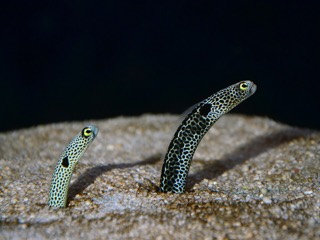 Yellow Garden Eel (reference photo)

Species Data
- Classification
- Anguilliformes / Congridae Source
- Size
- Reaches a body length of up to 40 cm
- Diet
- Planktivore Feeds on zooplankton
- Distribution
- Found in the tropical western Indo-Pacific from the Maldives to Papua New Guinea and the Ryukyu Islands, living in sandy burrows on current-swept slopes at depths of 18-75 m, most commonly around 30 m. Source
- Sources
- ja.wikipedia.org
Did You Know?
- It is often mistaken for the similarly shaped spotted garden eel (Heteroconger hassi), but is a distinct species, scientifically named Gorgasia preclara. Source
- It digs a vertical burrow in the sand and lives alone or in small groups, usually keeping only its head and upper body exposed and retreating fully into the burrow when threatened. Source
Where to See This Species
Operating facilities registered on this site: Japan 4
Osaka Aquarium KaiyukanOsakaOpened in 1990
Aquarium in Itabashi, TokyoTokyoOpened in 1994
Kagoshima City AquariumKagoshimaFrom Kagoshima-Chuo Station, take the tram (Route 2) to the Suizokukan-guchi stop and walk 8 minutes.
Niigata City AquariumNiigataOpened in 1990
Possible records, not yet confirmed: 1
These facilities are not confirmed by an official animal list. They appear in secondary sources such as Wikipedia; check the facility’s official website for current exhibits.
Sumida AquariumTokyoRight by Tokyo Skytree Station on the Tobu Skytree Line.
(Not confirmed by official sources) Source
Former facilities
Shima MarinelandMieOpened in 1970
(Not confirmed by official sources) Source
Closed: 2021-03-31 Official Site
Source links to official sites, official YouTube channels, and news aggregators such as Zoo Ring. Visit the publisher for the full item.
Conservation Story
Conservation Status
Least Concern (LC)
Sources
Support Conservation
A visit is a small, positive way to support the daily lives of the animals you care about.
- Visit
- A visit itself helps support the facility.
- Animal Supporter Programs & Giving
- Find ways to support the facility through its official website.
- Furusato Nozei
- Municipally run facilities may share official guidance for this Japanese hometown-tax program.
FAQ
- Where can I see Yellow Garden Eel in Japan?
- Operating facilities registered on this site: Japan 4 (Osaka Aquarium Kaiyukan, Aquarium in Itabashi, Tokyo, Kagoshima City Aquarium, and 1 more). These facilities are confirmed by resident animal records or the facility’s official information. Source
- Is the yellow garden eel the same species as the spotted garden eel (chinanago)?
- No. Although the two look similar and are often kept together in aquariums, the yellow garden eel is Gorgasia preclara while the spotted garden eel is Heteroconger hassi — two distinct species. Source
- How big does a yellow garden eel get?
- It can reach up to about 40 cm in length. Source
- Where do yellow garden eels live?
- They inhabit sandy, current-swept reef slopes in the tropical western Indo-Pacific, from the Maldives to Papua New Guinea and Japan's Ryukyu Islands, at depths of roughly 18-75 m. Source
Books & gear
Source: ja.wikipedia.org en.wikipedia.org