Alligator Snapping Turtleワニガメ
Macrochelys temminckiiEN— Endangered
The alligator snapping turtle is one of the heaviest freshwater turtles in the world, native to river systems of the southeastern United States. It hunts by lying motionless on the riverbed and wiggling a worm-shaped lure on its tongue to draw fish into its powerful jaws. Decades of overharvesting have pushed the species into decline, and it is now assessed as Endangered by the IUCN.
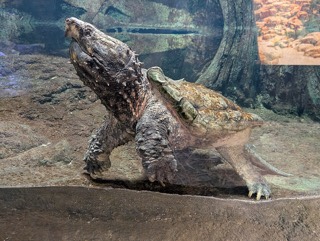 Alligator Snapping Turtle (reference photo)

Species Data
- Classification
- Testudines / Chelydridae Source
- Size
- Carapace length up to about 80 cm
- Weight
- About 8.4–80 kg; the record is 113 kg (an individual at the Shedd Aquarium)
- Lifespan
- Said to be about 80–120 years in the wild, with cases of over 150 years and estimates reaching 200; about 20–70 years in captivity
- Diet
- Carnivore Ambush carnivore that lures fish by wiggling a worm-like appendage on the tip of its tongue; also eats mollusks, carrion, and amphibians
- Distribution
- Endemic to the southeastern United States, ranging from the Florida Panhandle west to East Texas and north to southeastern Kansas, Missouri, and southern Illinois. Source
- Sources
- ja.wikipedia.org en.wikipedia.org
Did You Know?
- One of the heaviest freshwater turtles in the world, it lies on the riverbed with its camouflaged mouth open, wiggling a worm-like lure on its tongue to attract fish in a form of aggressive mimicry. Source
- Its bite is powerful enough to snap a broom handle, yet no human deaths from its bite have ever been recorded, and it is considered less aggressive than the related common snapping turtle. Source
Where to See This Species
Operating facilities registered on this site: Japan 9
Ishikawa DoubutsuenIshikawaAbout 60 minutes from the Kanazawa-Morimoto Interchange on the Hokuriku Expressway, about 40 minutes from the Kanazawa-Nishi Interchange, and about 20 minutes from the Komatsu Interchange.
Echizen Matsushima AquariumFukuiOpened in 1959
Kiryuugaoka DoubutsuenGunmaIf driving, set your car navigation to "Kiryugaoka Amusement Park" (Kiryugaoka Yuenchi) rather than "Kiryugaoka Zoo" to reach the parking lot (searching by the zoo name may give an incorrect route).
Hirakawa ZooKagoshimaAbout a 20-minute walk from Goino Station on the JR Ibusuki-Makurazaki Line, or take a bus bound for Taniyama / Dobutsuen from Fukuhira Nokyo-mae to the last stop.
Naganoshichausuyama DoubutsuenNaganoThe nearest station is JR Shinonoi Station.
Toba AquariumMieOpened in 1955
Tennoji ZooOsakaOpened in 1915
TOBU ZOOSaitamaFrom Tobu-Dobutsu-Koen Station (west exit), about 10 minutes on foot (600 m) or about 5 minutes by bus.
Higashiyama Zoo and Botanical GardensAichiOpened in 1937
Source links to official sites, official YouTube channels, and news aggregators such as Zoo Ring. Visit the publisher for the full item.
Conservation Story
Conservation Status
Endangered (EN)
Sources
Support Conservation
A visit is a small, positive way to support the daily lives of the animals you care about.
- Visit
- A visit itself helps support the facility.
- Animal Supporter Programs & Giving
- Find ways to support the facility through its official website.
- Furusato Nozei
- Municipally run facilities may share official guidance for this Japanese hometown-tax program.
FAQ
- How does the alligator snapping turtle catch fish?
- It lies still on the riverbed with its mouth open, wiggling a pink, worm-shaped appendage on its tongue to lure fish within striking range. Source
- How long can it live?
- It is believed capable of living up to 200 years, though 80 to 120 years is considered more typical in the wild. Source
- How many operating facilities are registered here?
- Operating facilities registered on this site: Japan 9 Source
Books & gear
Source: ja.wikipedia.org en.wikipedia.org