Giant Pandaジャイアントパンダ
Ailuropoda melanoleucaVU— Vulnerable
The giant panda is a bear species native to a handful of mountainous bamboo forests in central China, instantly recognizable by its black-and-white coat. Though classified within the order Carnivora, it has adapted to a diet that is roughly 99% bamboo, spending more than half its day feeding to compensate for poor digestive efficiency. Once Endangered, the species was reclassified as Vulnerable by the IUCN in 2016 following decades of conservation efforts, though it remains entirely dependent on China's loan-based "panda diplomacy" program for its presence in zoos abroad, including, until early 2026, in Japan.
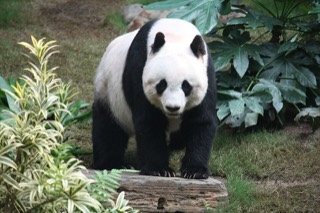 Giant Panda (reference photo)

Species Data
- Classification
- Carnivora / Ursidae Source
- Size
- Body length 120–190 cm
- Weight
- In the wild, males about 100 kg and females about 90 kg; in captivity they may reach about 120 kg and 100 kg, respectively
- Lifespan
- Typically around 26 years in captivity, though some individuals have lived 34–38 years
- Diet
- Herbivore Bamboo makes up about 99% of the diet; eats 9–18 kg of bamboo a day (up to 38 kg when eating water-rich bamboo shoots)
- Activity
- Spends more than half of its active hours (about 14 hours on average) feeding
- Distribution
- Restricted to a handful of mountainous bamboo-forest regions in central China, primarily Sichuan Province with smaller populations in Shaanxi and Gansu. Source
- Sources
- ja.wikipedia.org en.wikipedia.org
Did You Know?
- Despite belonging to the order Carnivora, giant pandas rely on bamboo for about 99% of their diet, and their inefficient digestion means they may defecate up to 40 times a day. Source
- A modified wrist bone forms a "false thumb" that lets giant pandas grip bamboo stalks despite lacking an opposable digit—the same trick independently evolved by the unrelated red panda. Source
- Since the 1970s, China has practiced "panda diplomacy," lending giant pandas to foreign zoos as a gesture of goodwill; when Ueno Zoo's twin pandas Xiao Xiao and Lei Lei were returned to China on January 27, 2026, Japan was left, for the first time in decades, with no giant pandas on display. Source
Where to See This Species
Operating facilities registered on this site: Japan 8
Adventure WorldWakayamaOpened in 1978
Asahiyama ZooHokkaidoOpened in 1967
Yokohama Shiritsu Nogeyama DoubutsuenKanagawaOpened in 1951
Kyoto City ZooKyotoOpened in 1903
IKEDA ZOOOkayamaFrom the West Exit of JR Okayama Station, take an Okaden Bus bound for Chuo Byoin (Central Hospital) to the Kyoyama Iriguchi stop, then walk about 12 minutes.
Fukuoka Zoo & Botanical GardenFukuokaOpened in 1953
Temporarily closed facilities
Temporarily closed Official Site
FAQ
- Why does a carnivore eat almost only bamboo?
- Giant pandas evolved from carnivorous ancestors but shifted to an almost entirely bamboo diet; they retain a carnivore-type digestive tract, which is why they must eat large quantities—up to about 18 kg a day—and spend roughly 14 hours a day feeding to get enough nutrition. Source
- Are giant pandas still endangered?
- The IUCN downgraded the giant panda from Endangered to Vulnerable in 2016 after sustained conservation efforts increased the wild population to an estimated 1,900 individuals, though the species remains dependent on continued habitat protection. Source
- Are there any giant pandas in Japan now?
- As of early 2026, no. Adventure World in Wakayama returned its four pandas to China in June 2025, and Ueno Zoo's twins, Xiao Xiao and Lei Lei, were returned on January 27, 2026, under China's fixed-term panda loan agreements—leaving Japan without a giant panda on public display for the first time in years. Source
- How many operating facilities are registered here?
- Operating facilities registered on this site: Japan 8 Source
Books & gear
Source: www.tokyo-zoo.net www.tokyo-zoo.net www.aws-s.com www.aws-s.com www.iucnredlist.org