Grey Crowned Craneホオジロカンムリヅル
Balearica regulorumEN— Endangered
The grey crowned crane is a striking African crane crowned with a fan of stiff golden feathers, the national bird of Uganda. Unlike most cranes, it can roost in trees thanks to a specialized hind toe, but habitat drainage, overgrazing, and pesticide pollution have pushed the species to Endangered status.
Operating facilities registered on this site: Japan 13 (Zoo in Kiryū, Gunma, Matsue Vogel Park, Chiba Zoological Park, and 10 more). These facilities are confirmed by resident animal records or the facility’s official information.
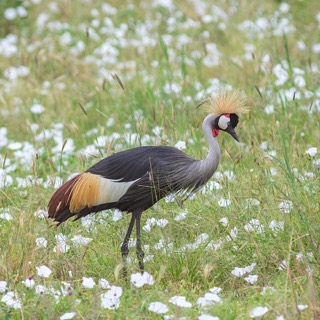 Grey Crowned Crane (reference photo)

Species Data
- Classification
- Gruiformes / Gruidae Source
- Size
- Total length about 100 cm
- Weight
- About 3.5 kg
- Lifespan
- No detailed records available
- Diet
- Omnivore Omnivorous, eating insects and other arthropods, small mammals, fruit, and seeds
- Distribution
- Found across sub-Saharan Africa, from the Democratic Republic of Congo and Uganda through Kenya to South Africa, with populations also in Angola and Namibia; it is the national bird of Uganda. Source
- Sources
- ja.wikipedia.org en.wikipedia.org
Did You Know?
Where to See This Species
Operating facilities registered on this site: Japan 13
Zoo in Kiryū, GunmaGunmaOpened in 1953
Matsue Vogel ParkShimaneOpened in 2001
Chiba Zoological ParkChibaOpened in 1985
ITOZU NO MORI Zoological ParkFukuokaOpened in 2002
Shizuoka Municipal Nihondaira ZooShizuokaOpened in 1969
Fukuchiyama City ZooKyotoInside Sandanike Park.
HIMEJI CENTRAL PARKHyogoFrom the north exit of JR Himeji Station, take the Shinki Bus bound for Himeji Central Park (fare: adults ¥590, children ¥300).
IKEDA ZOOOkayamaFrom the West Exit of JR Okayama Station, take an Okaden Bus bound for Chuo Byoin (Central Hospital) to the Kyoyama Iriguchi stop, then walk about 12 minutes.
Izu Animal KingdomShizuokaOpened in 1977
Kurume City Bird CenterFukuokaLocated at 1667 Higashi-Kushihara-machi, Kurume, Fukuoka, inside Chuo Park.
Neo Park OkinawaOkinawaAbout 15 minutes by car from the Kyoda Interchange on the Okinawa Expressway.
Sendai Yagiyama Zoological ParkMiyagiTake the Sendai Subway Tozai Line to Yagiyama Zoological Park Station; the zoo is right by the elevator from Central Exit 1 (about 12 minutes from Sendai Station).
Tokushima ZooTokushima
Possible records, not yet confirmed: 9
These facilities are not confirmed by an official animal list. They appear in secondary sources such as Wikipedia; check the facility’s official website for current exhibits.
Adventure WorldWakayamaOpened in 1978
(Not confirmed by official sources) Source
Ishikawa ZooIshikawaAbout 60 minutes from the Kanazawa-Morimoto Interchange on the Hokuriku Expressway, about 40 minutes from the Kanazawa-Nishi Interchange, and about 20 minutes from the Komatsu Interchange.
(Not confirmed by official sources) Source
Izu Shaboten ZooShizuokaOpened in 1959
(Not confirmed by official sources) Source
Hirakawa ZooKagoshimaAbout a 20-minute walk from Goino Station on the JR Ibusuki-Makurazaki Line, or take a bus bound for Taniyama / Dobutsuen from Fukuhira Nokyo-mae to the last stop.
(Not confirmed by official sources) Source
Suzaka ZooNaganoFrom the Suzaka-Nagano-Higashi IC on the Joshin-etsu Expressway, take Route 403, turn right at the Kotaka-machi intersection, turn left at the Kami-Hatcho intersection, cross Garyu Bridge, and turn left for the south entrance.
(Not confirmed by official sources) Source
Tennoji ZooOsakaOpened in 1915
(Not confirmed by official sources) Source
Fukuoka Zoo & Botanical GardenFukuokaOpened in 1953
(Not confirmed by official sources) Source
Higashiyama Zoo and Botanical GardensAichiOpened in 1937
(Not confirmed by official sources) Source
Wakayama Castle Park ZooWakayamaOpened in 1919
(Not confirmed by official sources) Source
Source links to official sites, official YouTube channels, and news aggregators such as Zoo Ring. Visit the publisher for the full item.
Conservation Story
Conservation Status
Endangered (EN)
Sources
Support Conservation
A visit is a small, positive way to support the daily lives of the animals you care about.
- Visit
- A visit itself helps support the facility.
- Animal Supporter Programs & Giving
- Find ways to support the facility through its official website.
- Furusato Nozei
- Municipally run facilities may share official guidance for this Japanese hometown-tax program.
- Support Zoo in Kiryū, Gunma
- Support Matsue Vogel Park
- Support Chiba Zoological Park
- Support ITOZU NO MORI Zoological Park
- Support Shizuoka Municipal Nihondaira Zoo
- Support Fukuchiyama City Zoo
- Support HIMEJI CENTRAL PARK
- Support IKEDA ZOO
- Support Izu Animal Kingdom
- Support Kurume City Bird Center
- Support Neo Park Okinawa
- Support Sendai Yagiyama Zoological Park
- Support Tokushima Zoo
FAQ
- Where can I see Grey Crowned Crane in Japan?
- Operating facilities registered on this site: Japan 13 (Zoo in Kiryū, Gunma, Matsue Vogel Park, Chiba Zoological Park, and 10 more). These facilities are confirmed by resident animal records or the facility’s official information. Source
- Why is the grey crowned crane special among cranes?
- It is one of only two crane species that can roost in trees, made possible by a long hind toe that lets it grip branches, unlike most cranes which must roost on the ground or in water. Source
- Why is the grey crowned crane endangered?
- Wetland drainage, overgrazing, and pesticide pollution have degraded its habitat across sub-Saharan Africa, and its global population is estimated at only 58,000 to 77,000 individuals. Source
Books & gear
Source: ja.wikipedia.org en.wikipedia.org