Japanese Giant Salamanderオオサンショウウオ
Andrias japonicusVU— Vulnerable
The Japanese giant salamander is a fully aquatic, nocturnal amphibian endemic to clear mountain streams in western Honshu, Shikoku, and parts of Kyushu, Japan. Growing up to 1.5 meters long, it ranks among the largest living amphibians and feeds mainly on fish and freshwater crustaceans. Protected in Japan as a Special Natural Monument, it is listed as Vulnerable on the IUCN Red List.
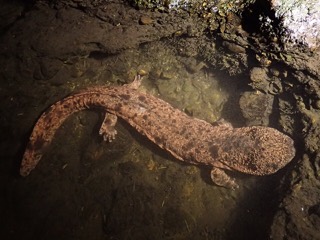 Japanese Giant Salamander (reference photo)

Species Data
- Classification
- Caudata / Cryptobranchidae Source
- Size
- Total length typically 50–70 cm; one individual reached a record 150 cm
- Weight
- A record of about 25 kg (an individual 150 cm in total length)
- Lifespan
- Wild: over 10 years (estimates suggest it may live nearly 80 years) / captive: record of 52 years
- Diet
- Carnivore Eats fish, crustaceans such as freshwater crabs, insects, and small animals such as snakes and Japanese water shrews
- Activity
- Nocturnal and fully aquatic; rests in burrows along the water's edge during the day
- Distribution
- Endemic to Japan, found in clear mountain streams and rivers across western Honshu (west of Gifu Prefecture), Shikoku, and parts of northern Kyushu. Source
- Sources
- ja.wikipedia.org en.wikipedia.org
Did You Know?
- Males guard strings of 400-500 eggs in nest burrows, protecting them for about 50 days until they hatch. Source
- It has poor eyesight but uses a lateral line system to sense vibrations in the water and locate prey. Source
- When threatened, it secretes a strong-smelling, milky substance to deter predators. Source
Where to See This Species
Operating facilities registered on this site: Japan 12
Kyoto AquariumKyotoAbout a 15-minute walk from the central exit of JR Kyoto Station.
Gokatsuraike Animal ParkMieAbout 10 minutes from the Seiwa-Taki Interchange.
Aquamarine FukushimaFukushimaOpened in 2000
Osaka Aquarium KaiyukanOsakaOpened in 1990
Kyoto City ZooKyotoOpened in 1903
Hiroshima City Asa Zoological ParkHiroshimaFrom JR Hiroshima Station, take the Sanyo Main Line or Kabe Line to Shin-Hakushima Station, transfer to the Astram Line to Kamiyasu Station, then take a bus to "Asa Dobutsu Koen" (about 45 minutes in total).
Kinosaki Marine WorldHyogoAbout 10 minutes by Zentan Bus from JR Kinosaki-Onsen Station; get off at the Hiyoriyama (Marine World) bus stop.
Suzaka ZooNaganoFrom the Suzaka-Nagano-Higashi IC on the Joshin-etsu Expressway, take Route 403, turn right at the Kotaka-machi intersection, turn left at the Kami-Hatcho intersection, cross Garyu Bridge, and turn left for the south entrance.
Tennoji ZooOsakaOpened in 1915
HIMEJI CITY AQUARIUMHyogoA 10-minute walk from Tegara Station on the Sanyo Electric Railway, or a 15-minute walk from JR Tegarayama-Heiwakoen Station.
Higashiyama Zoo and Botanical GardensAichiOpened in 1937
- 【大迫力】普段じっとしてるのに…#京都水族館 #オオサンショウウオ #生きた化石 #雑学 #京都観光 #水族館あるある
- 9月9日は「オオサンショウウオの日」
- このオオサンショウウオ何をたべている?#オオサンショウウオ #何をたべている #生き物の知恵 #脱皮中 #賢い #自然の神秘 #動物雑学 #ためになる #最後まで見て
- 【衝撃】オオサンショウウオのごはんを食べるシーン#オオサンショウウオ #生きた化石 #動物解説 #進化論 #水族館の日常 #ドキュメンタリー #雑学 #shorts #salamander
- オオサンショウウオの衝撃映像⚠️ #京都水族館 #京都観光 #夏休み #オオサンショウウオ #kyotoaquarium
- 保存必須⁉️オオサンショウウオの「見れたらラッキーシーン」🍀 #京都水族館 #オオサンショウウオ #京都旅行 #京都観光 #京都おでかけ
Source links to official sites, official YouTube channels, and news aggregators such as Zoo Ring. Visit the publisher for the full item.
Conservation Story
Conservation Status
Vulnerable (VU)
Support Conservation
A visit is a small, positive way to support the daily lives of the animals you care about.
- Visit
- A visit itself helps support the facility.
- Animal Supporter Programs & Giving
- Find ways to support the facility through its official website.
- Furusato Nozei
- Municipally run facilities may share official guidance for this Japanese hometown-tax program.
- Support Kyoto Aquarium
- Support Gokatsuraike Animal Park
- Support Aquamarine Fukushima
- Support Osaka Aquarium Kaiyukan
- Support Kyoto City Zoo
- Support Hiroshima City Asa Zoological Park
- Support Kinosaki Marine World
- Support Suzaka Zoo
- Support Tennoji Zoo
- Support Ueno Zoo
- Support HIMEJI CITY AQUARIUM
- Support Higashiyama Zoo and Botanical Gardens
FAQ
- How large can a Japanese giant salamander grow?
- It can reach up to about 1.5 meters (5 feet) in length and around 25 kilograms in weight, making it one of the largest living amphibians. Source
- What does the Japanese giant salamander eat?
- It preys mainly on fish and freshwater crabs, and also eats insects, frogs, and occasionally small mammals; it has a very slow metabolism and can go weeks without feeding. Source
- Where does the Japanese giant salamander live?
- It is endemic to Japan, living in clear mountain streams across western Honshu, Shikoku, and parts of northern Kyushu. Source
- How many operating facilities are registered here?
- Operating facilities registered on this site: Japan 12 Source
Books & gear
Source: ja.wikipedia.org en.wikipedia.org