Japanese Spiny Lobsterイセエビ
Panulirus japonicusLC— Least Concern
The Japanese spiny lobster is a large, nocturnal crustacean found on rocky reefs around Japan, Taiwan, China, and Korea, prized as a premium food item and a traditional New Year decoration. It can live for more than two decades and is known for its striking marching behavior, forming long single-file columns during the breeding season.
Operating facilities registered on this site: Japan 3 (Osaka Aquarium Kaiyukan, Shirahama Aquarium, Kyoto University, Niigata City Aquarium). These facilities are confirmed by resident animal records or the facility’s official information.
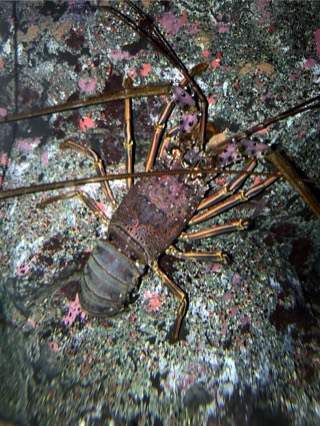 Japanese Spiny Lobster (reference photo)

Species Data
- Classification
- Decapoda / Palinuridae Source
- Size
- Body length usually about 20–30 cm, rarely approaching 50 cm; the Japanese record set in 2017 was 38.5 cm and 2.33 kg
- Lifespan
- Said to live over 20 years
- Diet
- Carnivore Carnivorous, preying mainly on various small animals such as mollusks and sea urchins, but also eats seaweed
- Activity
- Nocturnal; hides on rock ledges and in crevices by day and emerges at night to hunt
- Distribution
- Found in Pacific waters around Japan, Taiwan, China, and Korea, inhabiting shallow rocky reefs and coral areas exposed to open water. Source
- Sources
- ja.wikipedia.org en.wikipedia.org
Did You Know?
- During the breeding season, individuals form single-file marching columns, sometimes traveling 60 km over a week without rest or forming lines of around 60 lobsters. Source
- It is thought to share a mutually beneficial relationship with moray eels, helping protect each other from a shared predator, the octopus. Source
- Its larval stage, called the phyllosoma, drifts in the open ocean for roughly 300 days before settling. Source
Where to See This Species
Operating facilities registered on this site: Japan 3
Osaka Aquarium KaiyukanOsakaOpened in 1990
Shirahama Aquarium, Kyoto UniversityWakayamaOpened in 1930
Niigata City AquariumNiigataOpened in 1990
Possible records, not yet confirmed: 3
These facilities are not confirmed by an official animal list. They appear in secondary sources such as Wikipedia; check the facility’s official website for current exhibits.
Kagoshima City AquariumKagoshimaFrom Kagoshima-Chuo Station, take the tram (Route 2) to the Suizokukan-guchi stop and walk 8 minutes.
(Not confirmed by official sources) Source
Muroto Schoolhouse AquariumKochiOpened in 2018
(Not confirmed by official sources) Source
Kyoto AquariumKyotoAbout a 15-minute walk from the central exit of JR Kyoto Station.
(Not confirmed by official sources) Source
Source links to official sites, official YouTube channels, and news aggregators such as Zoo Ring. Visit the publisher for the full item.
Conservation Story
Conservation Status
Least Concern (LC)
Sources
Support Conservation
A visit is a small, positive way to support the daily lives of the animals you care about.
- Visit
- A visit itself helps support the facility.
- Animal Supporter Programs & Giving
- Find ways to support the facility through its official website.
- Furusato Nozei
- Municipally run facilities may share official guidance for this Japanese hometown-tax program.
FAQ
- Where can I see Japanese Spiny Lobster in Japan?
- Operating facilities registered on this site: Japan 3 (Osaka Aquarium Kaiyukan, Shirahama Aquarium, Kyoto University, Niigata City Aquarium). These facilities are confirmed by resident animal records or the facility’s official information. Source
- How big does the Japanese spiny lobster get?
- It typically grows to 20-30 cm long, occasionally reaching close to 50 cm; the largest verified Japanese specimen measured 38.5 cm and weighed 2.33 kg. Source
- Why do Japanese spiny lobsters form long lines?
- During the breeding season they sometimes migrate in single-file columns of dozens of individuals, occasionally covering around 60 km over a week without stopping to rest. Source
- How long do Japanese spiny lobsters live?
- They are thought to live more than 20 years. Source
Books & gear
Source: ja.wikipedia.org en.wikipedia.org