King Penguinキングペンギン
Aptenodytes patagonicusLC— Least Concern
The king penguin is the second-largest living penguin species, breeding in dense colonies on subantarctic islands across the South Atlantic and Indian Oceans. It feeds mainly on lanternfish and squid, diving to depths of over 300 meters, and has an unusually long breeding cycle that lets pairs raise only about two chicks every three years. Although currently listed as Least Concern with a growing population, climate change is projected to threaten many of its breeding grounds by the end of the century.
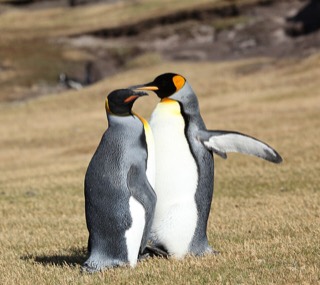 King Penguin (reference photo)
.jpg)
Species Data
- Classification
- Sphenisciformes / Spheniscidae Source
- Size
- Total length 85–95 cm (the second-largest living penguin after the emperor penguin)
- Weight
- 10–16 kg
- Lifespan
- One individual lived 39 years 9 months in captivity
- Diet
- Piscivore Prefers fish such as lanternfish but also eats squid; consumes 3.2–3.6 kg a day during the breeding season
- Distribution
- Breeds on subantarctic islands between roughly 45–55°S, including South Georgia, the Falkland Islands, the Crozet Islands, the Kerguelen Islands, and Macquarie Island. Source
- Sources
- ja.wikipedia.org en.wikipedia.org
Did You Know?
- During winter, when parental feeding drops sharply, chicks huddle together in groups called crèches to conserve body heat. Source
- King penguins can dive over 300 meters deep, with one recorded dive reaching 343 meters. Source
- Its breeding cycle lasts 14–16 months, so pairs typically raise chicks only about twice every three years. Source
Where to See This Species
Operating facilities registered on this site: Japan 10
How to tell Penguins apart →Nagasakipengin SuizokukanNagasakiOpened in 2001
Adventure WorldWakayamaOpened in 1978
Asahiyama ZooHokkaidoOpened in 1967
Osaka Aquarium KaiyukanOsakaOpened in 1990
Yokohama Hakkeijima Sea ParadiseKanagawaThe nearest station is Hakkeijima Station on the Seaside Line (connecting from Kanazawa-Hakkei Station on the Keikyu Line or Shin-Sugita Station on the JR Negishi Line).
Echizen Matsushima AquariumFukuiOpened in 1959
Shimoda AquariumShizuokaOpened in 1967
Noichi Zoological Park of Kochi PrefectureKochiA 20-minute walk or 13-minute rental-bicycle ride from Noichi Station on the Tosa Kuroshio Railway Gomen-Nahari Line.
Kinosaki Marine WorldHyogoAbout 10 minutes by Zentan Bus from JR Kinosaki-Onsen Station; get off at the Hiyoriyama (Marine World) bus stop.
Shimane Aquarium AQUASShimaneAbout 12 minutes on foot from JR Hashi Station (2 hours 23 minutes from JR Matsue Station to JR Hashi Station; 1 hour 24 minutes from JR Masuda Station).
Former facilities
Shima MarinelandMieOpened in 1970
Closed: 2021-03-31 Official Site
- キングペンギンお腹ポヨポヨ。【登別マリンパークニクス 】 #penguin #登別マリンパークニクス #動物 #登別#北海道
- 大迫力なキングペンギン🐧 【登別マリンパークニクス 】 #penguin #登別マリンパークニクス #動物 #登別#北海道
- キングペンギンのくちばし【登別マリンパークニクス】
Source links to official sites, official YouTube channels, and news aggregators such as Zoo Ring. Visit the publisher for the full item.
Conservation Story
Conservation Status
Least Concern (LC)
Sources
Support Conservation
A visit is a small, positive way to support the daily lives of the animals you care about.
- Visit
- A visit itself helps support the facility.
- Animal Supporter Programs & Giving
- Find ways to support the facility through its official website.
- Furusato Nozei
- Municipally run facilities may share official guidance for this Japanese hometown-tax program.
- Support Nagasakipengin Suizokukan
- Support Adventure World
- Support Asahiyama Zoo
- Support Osaka Aquarium Kaiyukan
- Support Yokohama Hakkeijima Sea Paradise
- Support Echizen Matsushima Aquarium
- Support Shimoda Aquarium
- Support Noichi Zoological Park of Kochi Prefecture
- Support Kinosaki Marine World
- Support Shimane Aquarium AQUAS
FAQ
- How deep can king penguins dive?
- They can dive more than 300 meters, with one recorded dive reaching 343 meters. Source
- How often do king penguins breed?
- Their breeding cycle lasts 14–16 months, so pairs typically raise chicks only about twice every three years. Source
- Are king penguins endangered?
- They are currently listed as Least Concern with an increasing population, though climate change is expected to threaten many breeding sites by 2100. Source
- How many operating facilities are registered here?
- Operating facilities registered on this site: Japan 10 Source
Books & gear
Source: ja.wikipedia.org en.wikipedia.org