Reeves' Pond Turtleクサガメ
Mauremys reevesiiEN— Endangered
Reeves's turtle, known in Japan as kusagame, is a semiaquatic pond turtle native to Korea and eastern China, with long-established but likely introduced populations in Japan and Taiwan. Mature males undergo dramatic melanism, turning almost entirely black, while juveniles are marked by distinctive yellow shell seams. Once common and still farmed by the millions in China for food, medicine, and the pet trade, the species is now classified as Endangered by the IUCN due to overharvesting, habitat loss, and competition from invasive red-eared sliders.
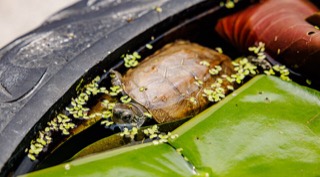 Reeves' Pond Turtle (reference photo)

Species Data
- Classification
- Testudines / Geoemydidae Source
- Size
- Carapace length up to 30 cm; males reach only about 19.9 cm
- Diet
- Omnivore Omnivorous; large individuals crush and eat mollusks and large crustaceans, shell and all
- Activity
- Basically diurnal, though some individuals become more crepuscular or nocturnal in summer
- Distribution
- Native to Korea and eastern to southeastern China; populations in Japan and Taiwan are believed to derive from historical human introductions rather than natural range. Source
- Sources
- ja.wikipedia.org en.wikipedia.org
Did You Know?
- Juveniles often have yellow seams along their carapace scutes, giving rise to the alternate Japanese name "golden-line turtle." Source
- Mature males over about 7 years old often undergo melanism, turning almost entirely black—including the eyes—and losing their juvenile markings. Source
- It has musk glands at the base of its limbs and releases a foul odor as a defense mechanism when threatened. Source
Where to See This Species
Operating facilities registered on this site: Japan 5
Gokatsuraike Animal ParkMieAbout 10 minutes from the Seiwa-Taki Interchange.
Kyoto City ZooKyotoOpened in 1903
Kiryuugaoka DoubutsuenGunmaIf driving, set your car navigation to "Kiryugaoka Amusement Park" (Kiryugaoka Yuenchi) rather than "Kiryugaoka Zoo" to reach the parking lot (searching by the zoo name may give an incorrect route).
Iida Shiritsu DoubutsuenNaganoAddress: 33 Ogimachi, Iida, Nagano.
Conservation Story
Conservation Status
Endangered (EN)
Sources
Support Conservation
A visit is a small, positive way to support the daily lives of the animals you care about.
- Visit
- A visit itself helps support the facility.
- Animal Supporter Programs & Giving
- Find ways to support the facility through its official website.
- Furusato Nozei
- Municipally run facilities may share official guidance for this Japanese hometown-tax program.
FAQ
- Is the Reeves's turtle native to Japan?
- Most evidence suggests it is not originally native—Japanese populations are believed to descend from turtles introduced from the Korean Peninsula, though the exact timing remains debated. Source
- Why do male Reeves's turtles turn black?
- Males over roughly 7 years old commonly develop melanism, a condition in which the body, including the eyes, darkens to almost solid black and the juvenile pattern disappears. Source
- Why is the Reeves's turtle endangered?
- Wild populations have declined sharply due to overharvesting for food and traditional medicine, pet-trade capture, habitat loss, and competition with invasive red-eared sliders, leading the IUCN to list it as Endangered. Source
- How many operating facilities are registered here?
- Operating facilities registered on this site: Japan 5 Source
Books & gear
Source: ja.wikipedia.org en.wikipedia.org