Snow Leopardユキヒョウ
Panthera unciaVU— Vulnerable
The snow leopard is an elusive big cat of Central and South Asia's high mountain ranges, from the Himalayas to the Altai, adapted to extreme cold with thick fur, fur-covered paws, and an exceptionally long tail used for balance and warmth. A powerful predator of wild sheep and goats, it can pursue prey down steep slopes for hundreds of meters, though unlike other Panthera species it cannot roar. With fewer than 10,000 mature individuals estimated in the wild, it is classified as Vulnerable by the IUCN and threatened by poaching, habitat loss, and climate change.
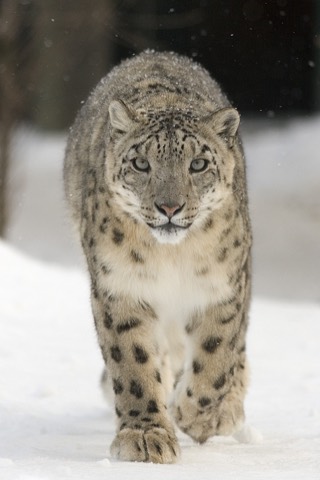 Snow Leopard (reference photo)

Species Data
- Classification
- Carnivora / Felidae Source
- Size
- Head-body length: males 104–125 cm, females 86–117 cm; tail 78–105 cm (75–90% of body length)
- Weight
- Males 25–55 kg, females 21–53 kg
- Lifespan
- Wild: over 10 years (some suggest up to 21 years) / captive: record of 25 years
- Diet
- Carnivore Preys mainly on large ungulates such as argali, Siberian ibex, and bharal, and also eats rodents, small mammals, and birds; it sometimes attacks livestock, which makes up 53% of the diet in some regions
- Activity
- Mainly crepuscular and nocturnal, but also active by day in areas with few people and in winter; travels 10–12 km (up to 28 km) a day
- Distribution
- Native to the mountain ranges of Central and South Asia, from eastern Afghanistan through the Himalayas, the Tibetan Plateau, southern Siberia, Mongolia, and western China, at elevations of roughly 3,000–4,500 m. Source
- Sources
- ja.wikipedia.org en.wikipedia.org
Did You Know?
- Its exceptionally long, thick tail—75 to 90% of body length—helps with balance while hunting on steep terrain and doubles as a blanket, wrapped around the face for warmth while resting. Source
- Despite belonging to the genus Panthera, the snow leopard cannot roar, because its vocal folds are only about 9 mm long and provide too little resistance to airflow. Source
- Snow leopards can actively pursue prey down steep mountainsides for up to 300 meters, using the momentum of an initial leap, and their fur-covered paws help prevent slipping on snow. Source
Where to See This Species
Operating facilities registered on this site: Japan 10
Asahiyama ZooHokkaidoOpened in 1967
Ishikawa DoubutsuenIshikawaAbout 60 minutes from the Kanazawa-Morimoto Interchange on the Hokuriku Expressway, about 40 minutes from the Kanazawa-Nishi Interchange, and about 20 minutes from the Komatsu Interchange.
Hamamatsu Zoological GardensShizuokaOpened in 1950
Kumamotoshi DoushokubutsuenKumamotoTake the tram bound for Kengun and get off at the Doshokubutsuen-Iriguchi stop, then walk 10 minutes.
Sapporoshimaruyama DoubutsuenHokkaidoOpened in 1951
Akitashioomoriyama DoubutsuenAkitaFrom bus stop 7 at the west exit of the JR Akita Station bus terminal, take the Akita Chuo Kotsu "Araya Line" bus for about 30 minutes.
Omuta City ZooFukuokaOpened in 1941
Higashiyama Zoo and Botanical GardensAichiOpened in 1937
Source links to official sites, official YouTube channels, and news aggregators such as Zoo Ring. Visit the publisher for the full item.
Conservation Story
Conservation Status
Vulnerable (VU)
Sources
Support Conservation
A visit is a small, positive way to support the daily lives of the animals you care about.
- Visit
- A visit itself helps support the facility.
- Animal Supporter Programs & Giving
- Find ways to support the facility through its official website.
- Furusato Nozei
- Municipally run facilities may share official guidance for this Japanese hometown-tax program.
FAQ
- Why does the snow leopard have such a long tail?
- Its tail, which can be 75 to 90% of its body length, helps it balance while hunting on steep, rocky terrain and doubles as a wrap-around blanket to protect its face from the cold while resting. Source
- Can snow leopards roar?
- No. Although they belong to the same genus as lions and tigers, snow leopards cannot roar because their vocal folds are only about 9 mm long, too short to generate the resistance needed to roar. Source
- How many snow leopards are left in the wild?
- The global population is estimated at fewer than 10,000 mature individuals, and it is projected to decline further, leading the IUCN to classify the species as Vulnerable. Source
- How many operating facilities are registered here?
- Operating facilities registered on this site: Japan 10 Source
Books & gear
Source: www.city.asahikawa.hokkaido.jp www.tokyo-zoo.net www.ishikawazoo.jp www.hamazoo.net www.iucnredlist.org