South American Sea Lionオタリア
Otaria flavescensLC— Least Concern
The South American sea lion is a large eared seal found along the coasts of South America, from northern Peru to southern Brazil. Males are markedly larger than females and grow a thick mane, giving the species one of the most pronounced cases of sexual dimorphism among sea lions. It feeds mainly on fish and cephalopods, occasionally taking penguins, and the IUCN lists it as Least Concern with a stable population of roughly 265,000.
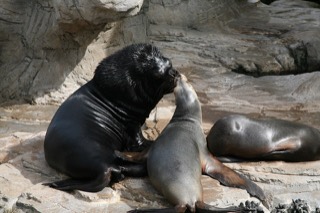 South American Sea Lion (reference photo)

Species Data
- Classification
- Carnivora / Otariidae Source
- Size
- Males about 3 m / females about 2 m
- Weight
- Males about 350 kg / females about 150 kg
- Diet
- Carnivore Feeds mainly on fish such as Argentine hake and anchovies and on cephalopods, and sometimes preys on birds such as penguins and pelicans
- Distribution
- The South American sea lion ranges along South American coasts from northern Peru around Cape Horn to southern Brazil, with major colonies at Peninsula Valdes (Argentina), Lobos Island (Uruguay), and the Falkland Islands. Source
- Sources
- ja.wikipedia.org en.wikipedia.org
Did You Know?
- Among eared seals, the South American sea lion shows especially pronounced sexual dimorphism, with males developing a thick mane around the neck and shoulders. Source
- In addition to the typical territorial harem system, some Peruvian populations exhibit lek-like breeding behavior, in which males gather in a shared display area to attract females. Source
- The ancient Moche people of Peru depicted the South American sea lion in their pottery and textile art. Source
Where to See This Species
Operating facilities registered on this site: Japan 9
Sunshine AquariumTokyoFrom Ikebukuro Station (Exit 35), walk along Sunshine 60 Street.
Miyajima Public AquariumHiroshimaOpened in 2011
Kushiroshi DoubutsuenHokkaidoAbout 55 minutes from JR Kushiro Station by Akan Bus, or about 27 minutes (18 km) by car, taxi, or rental car.
Kumamotoshi DoushokubutsuenKumamotoTake the tram bound for Kengun and get off at the Doshokubutsuen-Iriguchi stop, then walk 10 minutes.
Otaru AquariumHokkaidoOpened in 1958
Kinosaki Marine WorldHyogoAbout 10 minutes by Zentan Bus from JR Kinosaki-Onsen Station; get off at the Hiyoriyama (Marine World) bus stop.
ENOSHIMA AQUARIUMKanagawaOpened in 2004
SENDAI UMINO-MORI AQUARIUMMiyagiOpened in 2015
Himeji Shiritsu DoubutsuenHyogoOpened in 1951
Former facilities
Keikyuuaburatsubomarin ParkKanagawaOpened in 1968
Closed: 2021-09-30 Official Site
Temporarily closed facilities
Shinyashima SuizokukanKagawaOpened in 1969
Temporarily closed Official Site
Source links to official sites, official YouTube channels, and news aggregators such as Zoo Ring. Visit the publisher for the full item.
Conservation Story
Conservation Status
Least Concern (LC)
Sources
Support Conservation
A visit is a small, positive way to support the daily lives of the animals you care about.
- Visit
- A visit itself helps support the facility.
- Animal Supporter Programs & Giving
- Find ways to support the facility through its official website.
- Furusato Nozei
- Municipally run facilities may share official guidance for this Japanese hometown-tax program.
FAQ
- Where do South American sea lions live?
- They inhabit coastal waters and rocky shores all along the South American coastline, from northern Peru on the Pacific side, around Cape Horn, to southern Brazil on the Atlantic side. Source
- What do South American sea lions eat?
- They primarily eat fish such as Argentine hake and anchovies along with squid and octopus, and are also known to occasionally prey on penguins and other seabirds. Source
- Are South American sea lions endangered?
- No, the IUCN classifies the species as Least Concern, with an estimated stable population of around 265,000 individuals. Source
- How many operating facilities are registered here?
- Operating facilities registered on this site: Japan 9 Source
Books & gear
Source: ja.wikipedia.org